Tag: synchronicity

  • Sunset

    The work of wisdom is to differentiate between what is skillful, and what is unskillful. ~ The Daily Tejaniya

    My days continue to include bike rides and sharing with Fred. It has been two months and two days since Linda died.

    We ride and talk. Most days we have a water break sitting somewhere or another.

    We talk about Linda, about the loss we feel, about our lives that loom much smaller than they did decades ago.

    Following this morning’s ride — taken in cloudy, breezy, chilly conditions — I read again from Ram Dass Here and Now #176 – Loving and Dying:

      So, a lot of the work that you are doing in a lifetime is the preparation for the moment of death, and keeping death present enriches the moment of life. That the optimum way to be healed is the optimum way to die, which is your full consciousness. But your full consciousness listens, does what it can to preserve the precious human body, but also allows what is to be, and a lot of people lose it because they are so attached to which way it all goes all the time.

      Like, I work with people that are having a slow illness, terminal illness, and they are losing their motor abilities and their control (sphincter controls and things) and each stage they lose, I watch some people who are able to open to the new stage and say, “Ah, so….” and those people don’t suffer. And then I watch somebody who looks at the shoes in the closet that they’ll never wear again and sits around feeling sorry because they can’t wear the shoes anymore. They’re holding onto the model of who they were a moment ago. A moment ago, they were somebody wearing those shoes, and now they are not wearing those shoes.

      The minute you let go into what is, “Ah….”

      The minute you hold onto the model of what might be, or what ought to be, or what should be, or what was: suffering. It’s that disparity that creates the suffering. So that any time there is suffering, it’s a clue to where your mind is holding, and that is why you keep using suffering.

    We also talked about the story of the Two Wolves. From Wikipedia: It is a legend of unknown origin, commonly attributed to Cherokee or other indigenous American peoples in popular retelling. The legend is usually framed as a grandfather or elder passing wisdom to a young listener; the elder describes a battle between two wolves within one’s self, using the battle as a metaphor for inner conflict. When the listener asks which wolf wins, the grandfather answers, “Whichever one you feed”.

    Fred spoke of the loss of Linda like a backpack that is weighing him down making it difficult for him to move forward. I suggested he might choose to set the backpack down.

    Another quote from the Loving and Dying podcast by Ram Dass:

    Maharishi, the saint, was dying of cancer and those around him were saying, “Don’t leave us. Don’t leave us.”

    He looked confused and said, “Don’t be silly. Where could I go? I am just dropping the body. I am not going anywhere.”

    And, so you realize that the grieving is part of the dramatic story line of your separateness, because you can’t grieve for something that didn’t go anywhere.

    Perhaps the skillful action is for us to not try to get rid of the emotions and not try to carry the weight of the loss.

    Last evening John and I were downtown St. Joe at sunset. The clouds were ablaze. Today on Facebook I saw a video of the same sky taken by our niece with her comment: “The sky last night was one of the most incredible ones I’ve ever seen. Some things just stir up the desire to worship the one who makes all of the beautiful things.”

    I added: “And makes all things beautiful.”

    Here are just two of the unedited photos of an extraordinary sunset.

    Evidence.

    Let those who have eyes see. Seeing beauty in what is IS skillful.
  • A Somatic Visitation

    He woke about 1:00 am feeling her leg slide up against his.

    Her skin felt cool — his warmed beneath the covers.

    His thoughts traveled instantaneously along the line of asking her how she had been able to get into bed without his help. She had navigated severe back challenges.

    She had undergone a major back surgery in hopes of relief from pain and an increase in physical activity. But heart-related issues had preceded the back surgery, and, ultimately, heart-related issues following the back surgery resulted in her choice to stop all medical intervention and embrace comfort care and end-of-life.

    This “somatic visitation” came two months to-the-day of her death.

    Quoting hospice physician Christopher Kerr in the article Common Signs Your Loved One is Visiting You: “Many people have told me that they have been gently touched. A brush against their arm, a hand on the shoulder or their hair being stroked. Some even sense a bed sinking as if someone has sat on it. This is usually comforting, with nearly 99% of people knowing who is trying to communicate.”

  • Meaningful Medical Musings

    It has been a week of mild medical stuff. I had a crown prep on Thursday with a new dentist. I always let folks know I experience anxiety about medical procedures. When I told Dr. Lisa, she said she totally understands, that she is afraid too. I said I sometimes cry. She responded, “So do I.”

    While she stepped out, the dental assistant confided she is the patient with the highest anxiety they see in their practice. They can barely get her to have her teeth cleaned. I wondered if that might have been what led her to become a dentist.

    Suddenly, the tears forming in my eyes were not for me. Deep compassion rose up in my chest and formed a lump in my throat. It must be challenging to have your work be uncomfortable for the recipient as you are feeling the anxiety yourself. In a marvelously mystical manner, my experience in the chair was transformed. There was no “I” in the experience. It was not “my” anxiety or/and “her” anxiety, there was just anxiety.

    As a child, one might be frightened of clowns. A pair was just hung in our great room after having been packed away for the past seven years. We love these clowns because they look like us!

    May all beings come to the end of suffering.

    I had a realization! The trauma I experienced from extensive dental work as a child occurred following the trauma of having been diagnosed and treated for polio – being restrained during a spinal tap then hospitalized in isolation where I was told if I stopped crying my mom would come and get me only to have her standing behind the glass, never allowed to hold me.

    Dr. Lisa’s trauma was a plastic surgeon having done something on her face along her eye. I don’t know why the procedure was being done but I do know her experience was as a young child, too.

    Her hands were too abrupt for my taste, but I had the strong sense of her wanting to get in and out of my mouth as quickly as possible so both of us could feel relief from anxiety.

    On Friday I had a complete eye exam. I love the doctor I see at Great Lakes Eye Care. He is one of the most present people I have ever met, a being-with so welcome in the medical profession. The conclusion of the exam was a mixed result. A new prescription will not significantly improve my vision as I had hoped. Cataracts have formed on both eyes. “They are ready for removal when you are ready,” he said.

    The good news is my vision in general should be much improved after the surgery, although I will still need glasses for reading. When John and I talked about it we decided I will wait until spring, We have a busy fall planned and the schedule feels too tight to get it all done. We plan to go South earlier in November than normal because Brad’s band (Apache Jericho) has a gig we want to be in Tennessee for.

    Crow is cawing outside my window and I can see three of them as I pull back the drapes. Native peoples recognize messages, meanings, and magic in every encounter so I look up Crow and read, “Spiritually, crows represent transformation, positive change, and intelligence. Seeing a crow is generally considered to be a good omen. Temporary and unexpected changes are coming, but the outcome will be positive.”

    Given the meaningful medical musings about experiences we have as a child, you might also appreciate this recent “Insights” article published in The Herald Palladium:

      As a Child
      by Reverend Debra Basham

      When I was a child, I spoke as a child. The opening of verse 11 from 1 Corinthians Chapter 13 speaks so clearly to a dangerous universal truth: each of us was a child. I understood as a child, I thought as a child…. You and I — and every other human being — have had experiences and perceptions that caused us to develop beliefs as a child. Some of those beliefs are not serving us as adults.
      We were sitting on my porch sharing. She is navigating emotions a parent feels when an adult child is gravely ill. This woman’s son is on a double lung transplant list.

      “How can I pray for God to take another parent’s child so my child can live?” she tearfully asked.

      “God would not take another parent’s child so that your child can live,” I assured her. Painful things happen. God does not “cause” bad things to happen any more than branches waving cause wind. A child, not knowing the truth about how wind results from the warm and cold currents far from where we are, believes something that is just not true.

      God’s love could motivate parents who lose a child to choose organ donation. Not donating the child’s organs would do nothing to spare the pain of loss, but donating them can allow beneficial results to come from such a devastating event.

      Developmental biologist Jean Piaget studied and recorded the intellectual development and abilities of infants, children, and teens. As he was doing so, he noticed nuances he called stages. In 1936, he documented that the brains of children work very differently than those of adults. While not all experts agree with his idea of stages, it is undeniable that children’s brains work differently. The way children think about a situation, rather than the situation itself, results in a particular emotion and behavior. Think about a monster under the bed, for example. The natural process of this thinking as a child can have serious complications in our adult life, such as the woman who could not pray for an organ donation for her son.

      A child experiences me/mine/you/yours and having or not having. One truck or one doll will be the experience. Either I have it, or you have it. The child’s experience develops into distorted beliefs. If you have something, I cannot have it. Either or thinking is born.

      Visiting with a friend who had lost her husband, we saw this dynamic in her feeling that she could not move from the house they shared because he was “present” in her memories there in a way he could not be if she lived elsewhere. A child feels “with” only when the physical locality is shared. Adult awareness sees the truth that no matter how far or how long we are in separate spaces from our loved ones, we remain together in our hearts.

      The good news is that every faith tradition has language to help us move beyond those distorted beliefs derived from experiences we had as a child. The child’s perspective is not bad or wrong, 1 Corinthians Chapter 13 expresses a universal truth: When I was a child, I spoke as a child. The result was that I understood as a child….

      Sacred scriptures also say we shall know the truth and the truth shall set us free. Quoting Paramahansa Yogananda: “All the world’s great religions are based on common universal truths, which reinforce rather than conflict with one another.”

      Perhaps spiritual growth is simply wisdom revealing that beliefs we developed as a child can bind and blind. Fortunately, we are adults now and can see clearly now how perfect peace results when we realize (see with real eyes) that.

  • Mamminaism – It’s Just the Way It Is

    Most days of late I’ve been riding bike with Fred. I guess that could have been a good title for this post, but it is about so much more than biking or Fred. But, Fred did share something about a guy named Mammina he worked with who would say something like this: “You can only have a problem if there is a solution. If there is no solution there can’t be a problem. It’s just the way it is.”

    They coined the term Mamminaism referring to this because it applied so often. I suggested we consider it a mantra as we navigate life with Linda now in spirit and us still here in form.

    God, grant me the serenity to accept the things I cannot change… the opening of The Serenity Prayer. I have been encouraging Fred to consider how what he is doing in form is contributing to her in spirit even now. I heard myself tell him that she does not have an emotional body now so she is in a pretty good space to support us. And given that there is no solution, her being in spirit and us being in form can’t be a problem. It is just the way it is.

    From the author page of Byron Katie: In the midst of a normal life, Katie became increasingly depressed, and over a ten-year period sank further into rage, despair, and thoughts of suicide. Then one morning, she woke up in a state of absolute joy, filled with the realization of how her own suffering had ended.

    Katie says it so clearly, “I am a lover of what is, not because I’m a spiritual person, but because it hurts when I argue with reality. We can know that reality is good just as it is, because when we argue with it, we experience tension and frustration.”

    I was experiencing a lot of tension and frustration today when I finally got to a real person at Microsoft about an email I received charging my account $450 dollars for Microsoft 365 Business. I have not yet found out if it is a legitimate charge and I guess it is true that in time, truth will reveal itself.

    The literal thought about awareness about what happens after death is one has to wait until we die to know. Well, that does not seem the best use of human resources to me, does it to you? In time, truth will reveal itself.

    I am grateful to have learned of the work by Dr. Allan L. Botkin, Psy.D., who discovered what has been termed Induced After Death Communication (IADC) in 1995. The protocol for IADC was derived from Eye Movement Desensitization and Reprocessing (EMDR), an evidenced-based treatment for trauma. “When the grief-related sadness surrounding the loss diminishes, clients generally experience a state of calmness, openness, and receptivity. In this state, about two-thirds to three-fourths of clients report experiencing a deep sense of connection with the deceased loved one, which may be experienced through sensory means (sight, sound, smell, taste, etc.) or as a “sense of presence” of the loved one. This sense of connection is a well-researched phenomenon referred to in the scientific literature as after-death communication.” ~ IADC Therapy and The Center for Grief and Traumatic Loss

    As Fred mines Linda’s worldly possessions — all of which were left behind — I have found my way back to decades of my journals. I find myself knowing I do not wish to leave everything to someone else when (NOT IF) I lay this body down. I had a near meltdown when I thought I was missing the years between 2012 and 2016 but I found one thin journal. This entry on September 26, 2012, was quite telling:

      Yesterday morning I whacked my heal on the door to the pantry. It bled and my right eye pupil got huge! I started on energy work immediately and took both Arnica and Rescue Remedy. In about 60-90 minutes the pupil was mostly normal. I have a scab but otherwise I’m okay.

      I blurted out, “WHO OPENED THAT DOOR?” There are only John and me here.

      I realized my mom’s blurting out, “WHO PUT THAT THERE?” when something fell out of the freezer had been seen as evidence of her unwillingness to take responsibility for her actions and her tendency to blame others. I saw yesterday that blurt came from a non-rational place. There was no thought, just a reaction. It was very humbling.

    Fred and I have talked a lot about The Drama Triangle Revisited from my days with Subtle Communication Systems (SCS). Fred is gaining insights, I am, too. Perhaps we are seeing the message one of Linda’s mugs that she had broken and he had put back together. He thought he had recalled there being a small triangular chip that he had needed to fix but we have both looked closely several times…. In time, truth will reveal itself.

    We are now here, and the wound is nowhere to be seen.

    It’s just the way it is.

  • A Motto for Living Life

    The times are urgent; let us slow down.

    ~ African Saying

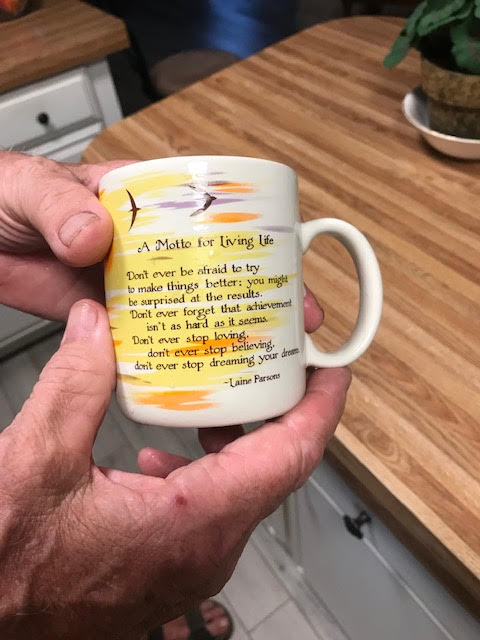
    He still had not found his coffee cup from a few days earlier although he distinctly remembered putting it in his car when he was leaving his friends’ home. The kitchen still dark, reaching into the cupboard to get yet another one, this time he pulls out hers.

    It was not just daylight that came with the dawn, it was also dawning on him that her mug was offering him another message:

      A Motto for Living Life

      Don’t ever be afraid to try
      to make things better: you might
      be surprised at the results.
      Don’t ever forget that achievement
      isn’t as hard as it seems.
      Don’t ever stop loving,
      don’t ever stop believing,
      don’t ever stop dreaming your dreams.
      ~ Laine Parsons

    Very unusual things are happening…. Going through the files in her desk he was getting to know her more deeply than he had known her within their life together of over 24 years. Her life was large. He could see now how much he had missed. Her passion for our world was compelling. He longed to share her vision for justice with the masses. He could imagine Ken Burns producing her story: Women’s Suffrage 2.0….

    She died one month ago today. One-twelfth of one year. It all seemed so otherworldly. He was drinking in her motto for living life.

    “It was a long time ago now. And it was yesterday.” ~ Kate Atkinson, Life After Life

  • Mr. Rogers Mug

    He could not find his coffee cup. He knew he had had it in the car when he had driven to a friend’s to bike from her home. The biking and sharing was part of his processing the grief.

    Maybe he had left his coffee cup on her porch.

    He went to the kitchen to get another cup.

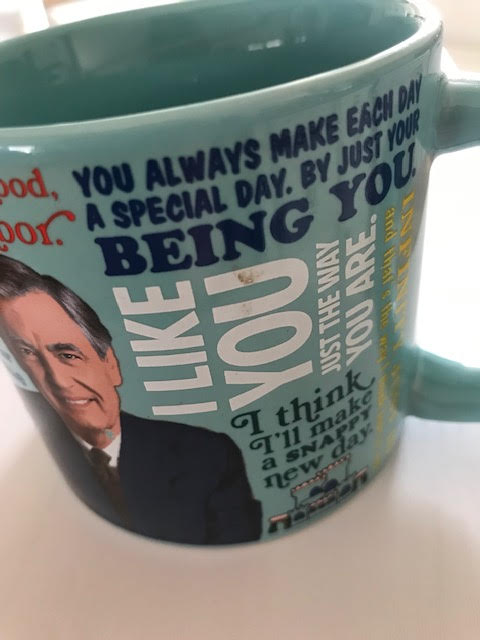
    His eyes went right to the Mr. Rogers mug!

    He began to read the messages:

      “It’s a good feeling to be with you.”

      “When we can talk about our feelings, they become less overwhelming, less upsetting, and less SCARY.”

      “Often when you think you’re at the end of something you’re at the beginning of something else.”

    Everything, absolutely everything, seemed to be helping him get through this challenging time. As his biking friend told him, “We don’t get over grief, we get through it…. because our loved ones leave their bodies but they don’t leave us.”

    This is the way Mr. Rogers says it on the mug:

      “Infinity just is and that’s the way I think love is, too.”
  • Seven Little Girls Sitting in the Backseat

    Fred was navigating the grief journey after his beloved had passed very suddenly (following a time of chronic health challenges) just four weeks ago. He had spent the evening with good friends who invited one of their neighbors to join them as a fourth for pizza and cards.

    They spoke openly of Fred’s journey, and shared the food and cards, along with some heartfelt laughter when the neighbor broke into song, making light fun of the lyrics of the Mac Davis song, “It’s Hard to be Humble.”

      Oh Lord it’s hard to be humble
      When you’re perfect in every way
      I can’t wait to look in the mirror
      Cause I get better looking each day
      To know me is to love me
      I must be a hell of a man
      Oh Lord It’s hard to be humble,
      But I’m doing the best that I can

    Later that night — at home alone, processing soooooo much — those lyrics became an earworm for him. (According to Wikipedia, an earworm or brainworm, also described as sticky music or stuck song syndrome, is a catchy or memorable piece of music or saying that continuously occupies a person’s mind even after it is no longer being played or spoken about.)

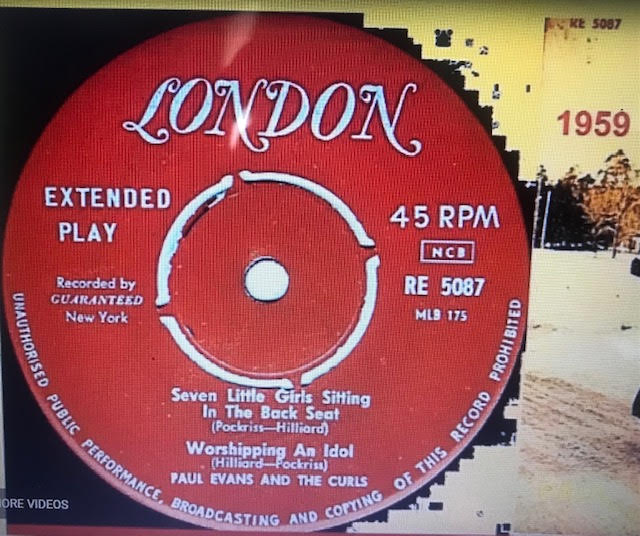
    When that earworm led to a second, Seven Little Girls Sitting in the Back Seat, by Paul Evans the chorus became a mantra:

      Keep you mind on your driving
      Keep you hands on the wheel
      Keep your snoopy eyes on the road ahead
      We’re having fun sitting in the back seat kissing and a-hugging with Fred

    It was as if she was giving him guidance to navigate his grief, making sure he knows — maybe especially now — it is vitally important to be having fun….

  • As-if Frame: Green Stick Bug

    The Library of Congress is the largest library in the world, with millions of books, films and video, audio recordings, photographs, newspapers, maps and manuscripts in its collections. The Library is the main research arm of the U.S. Congress and the home of the U.S. Copyright Office. According to the Library of Congress, “In the 5th century B.C., Empedocles and Anaxagoras offered arguments for the spherical nature of the Earth. During a lunar eclipse, when the Earth is between the sun and the moon, they identified the shadow of the Earth on the moon. As the shadow moves across the moon it is clearly round.”

    This information was not welcome.

    While at the University of Padua Galileo learned of Nicolaus Copernicus’ theory (published in 1543) that the Earth and all the other planets revolved around the Sun. Soon Galileo’s observations with the newly invented telescope convinced him of the truth of Copernicus’ sun-centered, or heliocentric theory.

    This information was not welcome either.

    All new ideas are met with three distinct phases: First they are ridiculed. Next they are resisted. Then they are accepted as the norm.

    Pondering all of this, I am reminded of the “As-if Frame” in NLP. From NLP World: “The intent of this frame is to make it easier for a person to explore possibilities and ideas internally, which would usually not be as available to them due to their limiting beliefs about themselves or others. The specific effect sought is to allow a person’s limiting beliefs to be temporarily set aside for the purpose of exploring alternate possibilities, without having to threaten or challenge their existing conceptual world-view in the process.”

    Obviously there is huge benefit to suspending beliefs that are not generating wholesome outcomes — perhaps most especially our own beliefs! And, using the “As-if Frame” is an easy way to see for yourself where beliefs you are holding are holding you back.

    Gary Zukav says the Universe is intimate. It is inside you, not outside.

    In 1981, James W. Fowler published Stages of Faith. Here is an excerpt from a pdf I found on line:

      Stage 1: This is the stage of preschool children in which fantasy and reality often get mixed together. However, during this stage, our most basic ideas about God are usually picked up from my parents and/or society.

      Stage 2: When children become school-age, they start understanding the world in more logical ways. They generally accept the stories told them by their faith community but tend to understand them in very literal ways. [A few people remain in this stage through adulthood.]

      Stage 3: Most people move into this stage as teenagers. At this point, their life has grown to include several different social circles and there is a need to pull it all together. When this happens, a person usually adopts some sort of all-encompassing belief system. However, at this stage, people tend to have a hard time seeing outside their box and don’t recognize that they are “inside” a believe system. At this stage, authority is usually placed in individuals or groups that represent one’s beliefs. [This is the stage in which many people remain.]

      Stage 4: This is the tough stage, often begun in young adulthood, when people start seeing outside the box and realize that there are other “boxes”. They begin to critically examine their beliefs on their own and often become disillusioned with their former faith. Ironically, the Stage 3 people usually think that Stage 4 people have become “backsliders” when in reality they have actually moved forward.

      Stage 5: It is rare for people to reach this stage before mid-life. This is the point when people begin to realize the limits of logic and start to except the paradoxes in life. They begin to see life as a mystery and often return to sacred stories and symbols but this time without being stuck in a theological box.

      Stage 6: Few people reach the stage. Those who do live their lives to the full in service of others without any real worries or doubts.

    We have come to see that many things thought about as “stages” are not linear in the way they were initially considered to be. A good example is the work around grief done by Dr. Elisabeth Kübler-Ross. You might want to look at Fowler’s stages of faith through an “As-if frame” allowing us to see even closely-held beliefs simply as having been developed.

    Following a recent day of meditation on line with others around the world, I saw a green stick bug in our yard. It literally emerged from a plant and looked directly at me. It felt significant enough that I looked up the spiritual meaning, and read it’s amazing message.

    Stick Bug symbolism is a reminder that life is full of illusions. Things that look like something but in reality are something entirely different. In other words, we have to see through what we perceive as fact to find the real truth hidden beneath it. Thus, it is now time to examine each of your beliefs one at a time so that you can discard anything that blinds you to reality. This process takes time. However, the Stick Bug meaning is a reminder that what you see is not necessarily what you get. This spirit animal insists that you open your eyes, ears, and mind today to discover a new truth.

    Especially at this time in human history, there is a need for a willingness to recognize the limits of logic and to see life as a mystery.

  • A Profound Truth

    She had received an email of condolence following the passing of a friend from heart failure. In her thank-you reply she shared a few more details including that her friend’s younger son had died of a bee sting at the age of 42, leaving her friend truly heart broken.

    “Her son will be thrilled to greet her….”

    Something about this idea did not sit softly so she wrote back, “I wish we didn’t just think of a reunion happening when we lay the body down but more understand the ongoing love across the veil. Do you know the Abler Soul work? I deeply resonate with it.”

    She sent a link to Sounds True Cynthia Bourgeault: When Two Become One: Love Beyond Death.

    https://resources.soundstrue.com/transcript/cynthia-bourgeault-when-two-become-one-love-beyond-death/?print=print

    Early the next morning she opened to the following message from Neale Donald Walsch, author of the Conversations with God series:

    On this day of your life I believe God wants you to know that there is a family reunion awaiting you, and you will be more overjoyed than you can now begin to imagine.

    On the day you leave your body — what I like to call your Continuation Day you will be greeted by everyone you have ever loved in any way for any reason… and, standing in front of the group, every person who has been so very dear to you. It will be a grand and glorious reunion, with joy and laughter and pure wonderment filling every heart and soul!

    This has also been experienced by everyone who has ever left here — all those who have gone before you — of course.

    So do not grieve for them. They are so very happy!

    I’m not sure why you were meant to hear this on this particular day…but I bet you are…

    Oh, yes, totally clear why she was meant to hear it on this particular day. She was having a conversation with God!

    As Niels Bohr said, “The opposite of a fact is falsehood, but the opposite of one profound truth may very well be another profound truth.”

  • Missing Metformin

    It was odd that he would doze off while they watched a bit of TV after dinner. He had done that a lot before being diagnosed with and treated for sleep apnea — but not since he had begun using a CPAP. He was faithful using it every night and even for his afternoon naps.

    This dozing had been happening for a few days. She thought back over the dinner menu, wondering if it been too heavy on carbs as he was also being treated for Type 2 diabetes.

    Saying softly, “You are dozing off again,” resulted in an emotional reaction. He was normally mind-mannered, so she stayed calm as she told him that reaction, too, might indicate something was going on. She suggested he test his glucose level to see and it was a little high but not alarming.

    During the dozing after dinner the previous evening they had considered having him take the Metformin with dinner rather than at bedtime with the rest of his medications and supplements. He got the bottle of Metformin out of the medicine cabinet to identify it in his PM dose but there was not one in the cup. Checking the two-week medication dispenser he discovered there was no Metformin in the following week either.

    How could they have missed the Metformin when they filled his two-week supply? As a precaution, they fill his meds together….

    They were both so thankful her “nagging” sense had led them to discover the missing Metformin.

    Note* One of the ways to harness intuition is to notice some of the signals of intuition. Signals are emotions like fear and anxiety, but also physical sensations—like feeling tense and persistent thoughts, dreams, and suspicions.