One of the most wonderful things about being a snowbird is winter biking — New Year’s Day riding in low wind with clear skies is heavenly. Thankful for sidewalks. Especially thankful for all of the benefits of being either in a canal community or an intentional residential community designed where there are cul de sacs.
Yes, it’s a little harder on the knees and quite a bit slower riding a route with so many tight turns, but the ride becomes more like walking a labyrinth. There’s something so freeing about knowing that you can’t get lost!
You can’t make a wrong turn. You can’t get injured or injure another by being somewhere that you shouldn’t be. There is a soft, easy, simple serenity to not having to think. You can just put one foot in front of the other or, as in my case this morning, just keeping my butt centered on the seat and the wheels turning round and round.
It is wonderful to be in an area with so many places where all I have to do is keep making right turns. This New Years Day route has so many streets I barely recognize any of the street names even thought I’ve probably ridden here half dozen or 10 times during last season and this year so far. I realized how wonderful it is to not feel the need to be vigilant with absolutely no sense of needing to know what street I’ve come from, what street I am now on nor what street might be coming up. I do not need to watch for a turn that might be coming up, or worry what might happen next. I have no sense at all I could be someplace I don’t know where I am, or anyplace other than right where I want to be. This is the freedom of right turns in the world of cul de sacs.
I’m riding with this wonderful feeling in my body I have felt over several decades of walking in a labyrinth. It’s total freedom from fear of doing something wrong. Somatic freedom.
Maybe it’s freedom from guilt.
It also feels like freedom from grief.
I certainly have been feeling a lot of both of those emotions over this recent past.
Last evening we were watching “Society of Snow,” based on the true story (1972) of a plane carrying members of a rugby team from Uruguay to Chile crashing in the Andes. A group of survivors lived through the plane crash, only to face the frigid cold and snow of the mountains, avalanches and, most famously, a lack of food. It is a very intense movie.
Not light viewing, intimately seeing how those who survived the crash and lived 72 days did so by cannibalizing those that did not. At a pivotal ending point I received a text message from Michigan friend, Doris, sharing a photo of one of her granddaughters in the foot massager that had been owned by Michigan friend, Linda, who died in July.
After Linda died and Fred was dispersing her worldly possessions, the foot massager is something I agreed to find a suitable home for. The first time I really felt how important it is to find loving homes for things that are left after a person’s worldly life ends was when John’s mom died. She was a lover of things and we took to heart finding others that would love the things she had loved. It was VERY meaningful….
With the taste of the film in my mouth, I saw the photo and read the text, “Everyone has been enjoying Linda’s foot massager. Much appreciation and gratitude,” and burst into tears.
I didn’t anticipate how hard it would be here in Florida without her. It’s complicated because her parting words for me were to take care of Fred so bicycle riding therapy became a significant lifeline for him and me in those weeks following Linda’s death. Then, quite quickly Fred partnered with their mutual friend. She seems to be good for him so I’m not begrudging that at all. I’m also not denying that I’ve not only lost Linda but I’ve now also lost Fred as a riding partner. It takes me back to other losses (especially those ongoing losses).
I found myself singing in my head the classic song “There’s a Hole in the Bucket.” The first stanza has Henry saying there is a hole in the bucket and Liza begins to coach him in how to fix it, including at the last part when Liza is telling Henry to use the bucket to carry the water! In the final stanza Henry responds: “But there’s a hole in the bucket, dear Liza, dear Liza. There’s a hole in the bucket, dear Liza, a hole.”
I heard myself singing inside my head, “There’s a whole in my heart, dear Linda, dear Linda. There’s a whole in my heart, dear Linda, a hole….”
As the days turned into weeks and months, those companions who knew they were nearing death began giving their blessings for their companions to eat them after they died. One young man even left a written note quoting John 15:13: ” Greater love hath no man than this, that a man lay down his life for his friends.” Touching and timely.
It is considered by many important to remember hearts only break in one direction: open.
An early morning phone call with a friend focused on shame. Her shocking statement was about being sick of feeling shame and the decision to not look at it, work with it, but to just be done with it. She decided to just say F&@K it…. if you know what she means.
I mentioned The Drama Triangle Revisited which is still available as a free download on the SCS-Matters website. The Drama Triangle was developed by Dr. Steve Karpman in 1968 (“Fairy Tales and Script Drama Analysis.” Transactional Analysis Bulletin, 7:26, 39-43), and it is vital to be aware because these roles are the raw fabric of our conditioned minds. Inescapable…. grateful awareness does offer release.
I did an internet search. Shame is not guilt. Guilt is about our having done something wrong. Shame arises from a core belief that there is something wrong with you. Shame is feeling you simply ARE not good enough. Shame is a hell of an emotion.
After our brief sharing, I listened to a Q & A session from a retreat at Plum Village. Interestingly, the feeling of core shame is intrinsic in Western culture, but not so much in Eastern. Perhaps this is the emphasis on being “born in sin” or “basic goodness” found in those world views. Here are a few nuggets from that Q & A session:
1. Being critical of shame is still being critical. The road of transforming “conditioned” habits is the path of recognizing the way thoughts lead to emotions and emotions form beliefs.
2. Notice criticism as it arises in thought. “Why are they doing that?” “Why are they wearing that?” “Why can’t I (you fill in the blank)?” Think of something opposite using the Metta Meditation: May you be safe. May you be happy. May you be healthy. May you be peaceful. Say these phrases over and over, breathing in and out, until you feel some compassion in your heart.
3. The tendency is to focus only on the difficult memory and the situation that has caused the deepest wound. We punish ourselves each time we keep repeating, reminding ourselves of that situation. Even in the pain, remember there is so much beauty in life. So much wonder. So much joy.
Our dance with the cockroaches continues…. I will spare the details but say only that last evening — while we had guests — I discovered the need to clean under the stove.
It is imperative to take a good look at our conditioned habits.
These are such timely reminders. All will benefit from deep cleaning!
Sometimes I need only to stand wherever I am to be blessed.
~ Mary Oliver
As we have nights with no cockroach sightings we began the conversation about how we will know when it is safe for us to stop the vigilant lifestyle of keeping everything in snap tight storage bins or Ziplock bags. As the end feels more possible, sightings that do occur produce more of a sense of contraction and a needing to fix — to get rid of — the problem. As I kill a cockroach I feel some sadness in my heart. I am finding it more challenging to stay in the present moment.
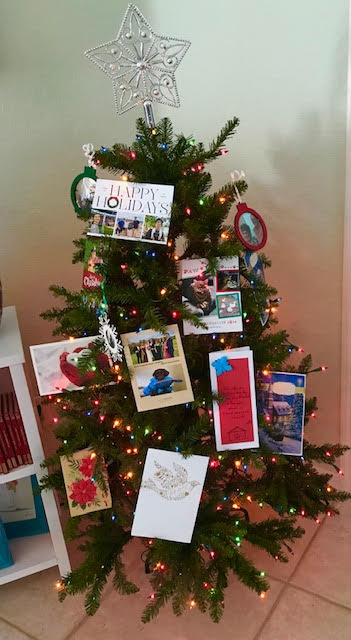
We had a lovely Christmas dinner with the owners of this home. Their own home has been rife with renovation since early June. They fired the contractor the end of last week. So, even though they do not have a kitchen, they brought a smoked prime rib. It was delicious food and delightful company. The Christmas tree they gifted us with has been decorated with the Christmas cards we have received.
I have been enjoying bird encounters on my bike rides, including some excellent Red Shouldered Hawk sightings, a pair of Florida Scrub Jays, and more than once I have seen a Limpkin. One bird I watched had a very unusual flight pattern. It moved in a rolling up and down action, reminding me of the way a dolphin plays in the wake as it follows a boat.
Biking and birding provides me with great meditative moments. This undulating action of the bird I had been watching (Woodpeckers, Finches, and some song birds undulate) stayed in my mind for days, resulting in a gift of great peace.
During a phone conversation, a friend asked me how I really am. I took that to mean what might be worrisome for me. I spoke briefly of the religious (literal) view of the Bible and the belief that Christians are the only humans a judging God is going to “save.” It is not that I have no experience with this world view. I see clearly having held that view and then having my faith deepen until I no longer hold that view. What has been baffling to me is seeing someone who had been free from dogma choose to go into it.
Seeing in my mind’s eye that bird moving smoothly up and down, feeling the motion of its rolling rising and falling brought to mind Ken Wilber’s stages of consciousness. The first tier stages move away from the stage that came before it; forward motion resulting from an away-from action. They are all associated with a sense of lack and needing the world to be different to how it is. We can see intolerance of others races, colors, sexes, or creeds; thinking is absolutist before we can take the perspective of all human beings. (Or, perhaps the perspective of a cockroach.)
The friend who had asked me how I really am shared a fun gift she and one daughter received from her other daughter. It is a pair of hand-holding socks. (If you cannot see the image of them here, please search for hand-holding socks so you can see them for yourself.) They are adorable. If a simple pair of socks can do it, so can we.
Oh, yes, Mary Oliver, sometimes I need only to stand wherever I am to be blessed….
She was sorry to have to say she could not come to sit with her husband’s cousin because she had an appointment the following morning, but during the night she received a message that her appointment had to be rescheduled.
Seeing that news, she traveled to offer her support. Their cousin was receiving hospice care at home, was not actively conscious, nearing the end of her life.
While she was there, she recalled how hearing is thought to be the last sense to remain, she read aloud to her the lovely Christmas card which had been received.
When she noticed no chest rising and falling she called for hospice to come. Their cousin was pronounced dead. May she rest in peace.
What profound gratitude came with the awareness of the changes outside of her human control that allowed her the privilege of being there that day. That awareness gently spread to other situations in her life which could bring forth concern.
“The world is held by unseen helping hands….”
History of Christmas cards*
Many of the Christmas traditions we celebrate today, like trees and crackers, all started in the Victorian era. The idea of sending Christmas cards become popular after the first commercially produced Christmas card was created by Sir Henry Cole in 1843. Early Christmas cards were expensive to produce.
May we rest in peace while we still have breath, rather than think we have to wait until we lay down these earth suits.
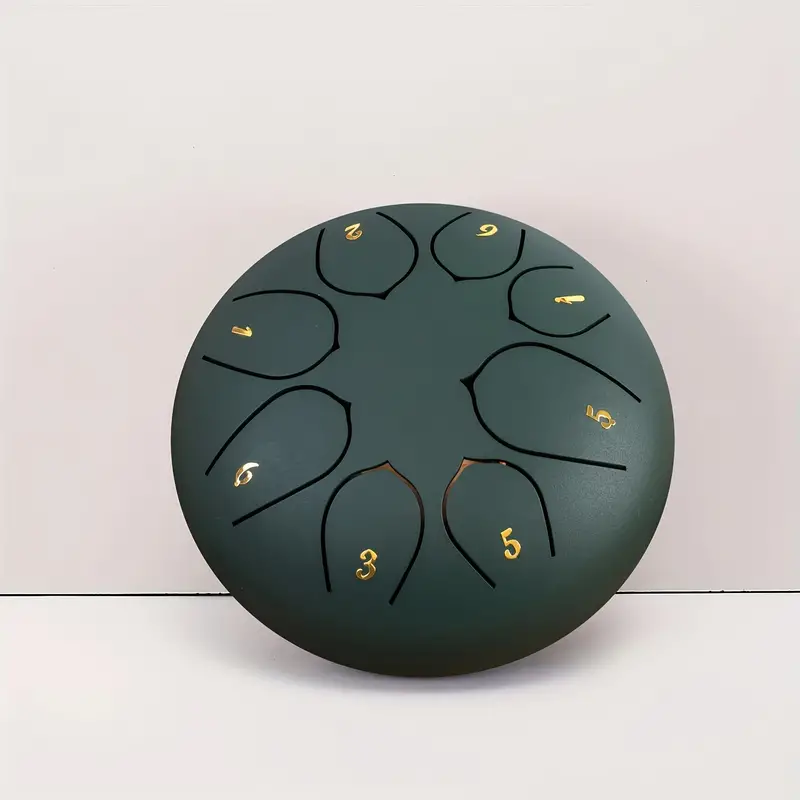
Enjoying time with life-long special music friends as we traveled to our seasonal home in Florida, a dear friend of theirs asked about my not having my SnareCraft drum with me. “It is buried in the van,” I responded, continuing, “I will have it with me the next time we get together. But I do have another new musical toy. It is a six-inch 8-note steel tongue drum.”
“Oh, my gosh! I have wanted one of those for years!” She excitedly went on, “I heard one in Shipshewana, but you know how it is. My money went to things for the kids.”
“I have one for you in the van. When I ordered mine I placed the order twice by mistake. I told John I must have gotten one for someone else but I just did not yet know for whom. Now I know. It is for you!”
The following day, her friend sent a text message: “Oh, it was so good to see you yesterday. I so enjoyed the music and the great conversation. When Patrick picked me up for dinner he said I was gleaming…. like a kid with a new toy…. I have been wanting a drum for so long and I am thrilled with it. Even trying a few easy songs. What a beautiful day…. thank you again.”
She is pure gift of love and support for our beloved friends. I can imagine their hearts having pushed that “place order button” the second time ordering the drum for her in gratitude for all she does for them. For sure, in the space where all is already known, it was known all along what special person the second steel tongue drum was for.
The following article, titled “Athleticism,” was written, proof-read (by my amazing beta reader, Linda Comerford) and submitted many (MANY) weeks ago. It was scheduled to be published in our local newspaper today, December 7, 2024. The email containing the article either was not received, or it was received and misplaced or deleted because it was received so early. Given that the message was/is tied into Pearl Harbor Day, I decided to deliver it via the Yellow Brick Road.
Sri Chinmoy said, “World-peace can be achieved when the power of love replaces the love of power.” A bit of information about the person who wrote this inspiring opening quotation might be helpful. Sri Chinmoy was born in 1931 in East Bengal, British India, (now Bangledesh). He lost his father to an illness in 1943 and his mother a few months later. Chinmoy began the practice of meditation when he was 11, and at age 12 he joined his brothers and sisters at Sri Aurobindo Ashram, where he spent the next 20 years in spiritual practice and study. After moving to New York City in 1964, Chinmoy taught in the United States — advocating a spiritual path to God through prayer and meditation and athleticism — including distance running, swimming, and weightlifting. You might be curious what running or swimming or weightlifting (athleticism) have to do with your spiritual wellbeing.
I looked up the meaning of athleticism, and in “What is Athleticism: The 10 Components You Must Know,” an article by James Breese, I read: Athleticism is formed by ten key components that make up balanced physical fitness, or what we refer to as complete athleticism. They are strength, speed, power, agility, anaerobic capacity, aerobic capacity, mobility, balance and coordination, mental resilience, and stability.
It is fascinating that a “spiritual” teacher would be encouraging students to become physically fit.
The answer is to be found in thinking about these ten key components. Strength. Speed. Power. Agility. Anaerobic and aerobic capacities — anaerobic activities are of short duration and high intensity; aerobic exercise is a rhythmic and repetitive physical activity that uses your body’s large muscle groups. (Examples of aerobic exercises include walking, cycling, and swimming. Aerobic exercise reduces your risk of heart disease, diabetes, high blood pressure, and high cholesterol.)
Mobility. Balance and coordination. Mental resilience. Stability.
The Christian New Testament says we are to think on whatever is true, honest, just, pure, lovely, of good report, or whatever has virtue or praise (Philippians 4:8). Look how these ideas overlap.
In the article “How Training the Mind is Like Riding a Horse,” Ed Halliwell tells us that good equestrians know the best way to ride a horse is by not trying to control it with fear, force, or frustration, but by listening and responding to the horse’s needs for reassurance, guidance, and gentleness. We adjust our journey based on the horse’s needs without losing sight of our intended destination. “In this way, rider and horse can travel in harmony, each taking charge according to its strengths.”
The modern world we live in is not the world of our ancestors. Most of us do not ride horses as a primary mode of transportation. However, we know human behavior, even in this current environment, is still similar in this way to animals. We have been seduced by social media, manipulated by Madison Avenue, held hostage by hordes of happenings, and tricked by the telling of tales darkly distorted so that they have very little to do with what is true, honest, just, pure, lovely, or of good report, virtue, or praise.
Strength. Speed. Power. Agility. Mobility. Balance. Coordination. Mental resilience. Stability. Perhaps these qualities from Philippians really are key. The scheduled publish date for this Insights article was December 7. When I saw that date, I remembered Pearl Harbor. On that day in 1941, Japanese planes attacked the United States Naval Base, killing more than 2,300 Americans.
An online inspiration, The Daily Tejaniya, articulates the truth so elegantly: “We need to learn our lessons. There is no shortcut. If we don’t learn our lessons when they present themselves, they will come up again and again until we give them our attention, and learn from them.”
World-peace can only be achieved when the power of love replaces the love of power, but world-peace can and will be achieved BECAUSE the power of love replaces the love of power.
John and I arrived safely at our winter home about 7:00 pm on Wednesday after a totally wonderful visit with John’s music mentor (and guitar benefactor!!!), Ed Bennett, his wife, Dee, and other great friends.
Yesterday my back was hurting and I could not find my Nikken mag roller. It usually travels in the outside zipper of my carry-on bag, and it usually lives in my sock drawer when I have landed. I distinctly remembered having unzipped and removed it, and the mini-sewing kit that travels with it was already in the sock drawer. I went to the guestroom closet to look again in my carry-on bag, and as I moved John’s guitar case it bumped the metal shelving and out scampered a gecko! I went in search of something to catch the gecko in and called for John to come help me. It was quite comical to watch the gecko stay ahead of me but I was finally successful in getting him (or her) safely outside.
I had a flashback to our first encounter with a gecko in the wild while we were in Puerto Vallarta, Mexico. John and I were scared silly and called a friend to come rescue us. When Jim arrived John and I were both standing up in the middle of the bed screaming!
Yes, our lessons will come up again and again until we learn from them.
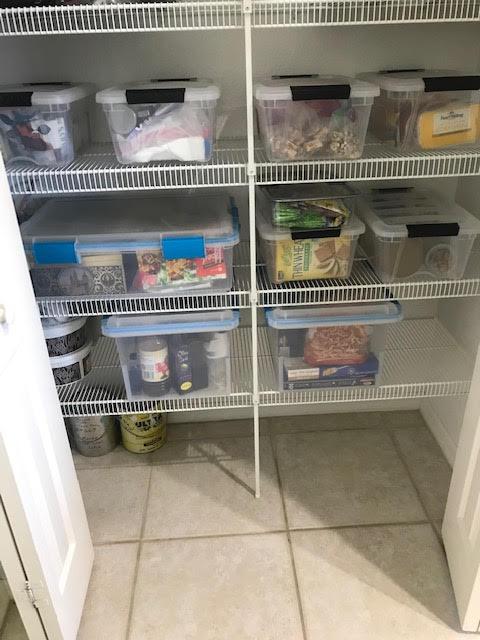
It has been a bit overwhelming settling in because, much to the embarrassment and regret of the homeowners, the house is still being treated for a roach infestation left by the previous renter. Howard, the technician came Thursday morning. (My dad’s name was Howard.) He walked me through what we need to do for the treatment to be successful. Essentially we need to be fastidiously clean. We have secured all of our food stuffs in clear totes.
We love this house and it’s owners so much…. When they came by late in the day on Thursday, we told them about a previous rental where we learned what we need to know and we assured them we will all work together and do what needs to be done. I also shared with them that cockroaches can have a variety of spiritual meanings. They are known for their ability to survive in harsh conditions, symbolism of the ability to thrive in the face of adversity. In some belief systems, cockroaches represent the cycle of life and death, encouraging personal transformation. They can also signify the need to shed old habits or beliefs to make way for new growth. And a skill that is very timely: cockroach symbolizes reality as contrasted to thoughts, allowing one to acknowledge a larger reality.
This morning when I killed an adult cockroach capable of creating many offspring, I felt such appreciation for its having made itself seen. I was taken back to a first encounter during our initial stay on Pine Island. John and I were both so grossed and freaked out he shot about a ten-foot stream of Raid spray onto the guy.
Reflecting on the unfortunate necessity of killing the cockroaches, I recalled the story of a master who was walking with a student when a dog charged at him. The master whipped off his belt and hit the dog soundly on the snout. The student was shocked, and criticized the master’s unskillfulness. Confidently and patiently, the master replied, “It was skillfulness. In an instant awareness knew the dog would rather be hit in the snout with the belt than the master bit in the leg by the dog.”
As Tejaniya writes, if we don’t learn our lessons when they present themselves, they will come up again and again until we give them our attention, and learn from them. Thank you, gecko; thank you, cockroach.
A beautiful affirmation from Betty Lue Lieber for today: I care about everyone and everything, including myself. I easily give my very best to all around me. I care enough to do the work with ease and grace. I create Good with all my caring.
Oh, life in the tropics! Everything in life showing us the power of love replacing the love of power!
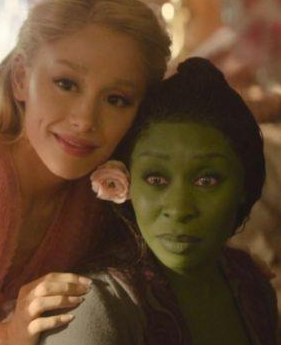
“Some things I cannot change, but ’til I try I’ll never know.” ~ Elphaba, in Wicked
Becky O’Brien’s review on Cinelix gave high praise for the film version: “Having seen the film, I can’t imagine any of the songs not being there, everything feels integral to the story, and that can be attributed to the film’s phenomenal cast. Cynthia Erivo and Ariana Grande in particular knocked it out of the park as Elphaba and Glinda respectively.”
Yesterday (November 27) John and I joined all of our “grand” daughters (Courtney, Christina and Rachel) to see the film before Stacey and Doug and Jackson and Brad and Adam joined us for dinner out celebrating John’s 76th birthday. At the movies we ate our weight in popcorn sitting back in theater seats that reclined, still leaving sufficient room for someone to walk by. It was amazing….
Rachel sent a text mid-morning:
A few fun facts from your fellow Ozain before the show.
Wicked is originally a novel published in 1995, followed by the Broadway adaptation debuted in 2004. Two decades later we have a film adaptation.
The Broadway play has two acts and this movie is act one. Intermission is one year long.
The movie set was built in the UK with minimal CGI. Almost everything you see on screen is real. They planted over 9 million tulips for munchkin land and built a 16 ton train for the emerald city and all the rest of the set is physical!! So cool!!
It took makeup 4-6 hours to paint Cynthia green everyday on set. Elphba and Glinda do all of their own stunts and sing live for EVERY musical number. Talent!!!
MGM still owns the rights to the ruby red slippers, which is why we will see nessa rose with silver slippers. (Just like the book.)
The last musical number defying gravity is arguably one of the hardest songs to sing in the theater. And Cynthia kills it while physically being suspended 40 ft in the air.
Stephan Schwartz is the composer and lyricist of Wicked. He read the book and 4 years later he had the whole musical scored and composed and all the lyrics written. Holy cow!!!
Although Dorothy is not relevant in act one, we do meet the scarecrow, the tin man and the lion in their original form. There are Easter eggs throughout the film to point you in the right direction to identify them.
I have 100 more. But I will bore you later. So excited today!!!!
I am already looking forward to part 2.
As it turned out, Stacey (who had not really wanted to go) would not have been able to join us because she watched Jackson so Courtney could go. It was pretty unanimous we thought Stacey would not have been wild about it. This morning Stacey asked me why I thought she would not have liked it.
That opened up a conversation about the power of myth, handed down from generation to generation via oral traditions and rituals. Myths were the way humans taught universal and eternal truths about life before the invention of writing. While themes reappear time and again in different culture, it is important to realize a myth is bound to the society and time in which it occurs. Thus, the details of a specific myth cannot be divorced from this culture and environment. (For example, a dying-and-rising god as first proposed in comparative mythology by James Frazer’s seminal The Golden Bough (1890). Frazer associated the motif with fertility rites surrounding the yearly cycle of vegetation and cited the examples of Osiris, Tammuz, Adonis and Attis, Zagreus, Dionysus, and Jesus.)
Seeing Wicked: Part One was soothing to my soul.
Myth speaks so much more clearly when not shrunk into a literal view.
As we were leaving the theater, I said to Rachel, “You may not know that my blog is titled Yellow Brick Road. I named it that because I saw in the Wizard of Oz the metaphor of the colors of the chakras: ruby red slippers (root chakra); yellow brick road (solar plexus); Emerald City (heart chakra).”
This is a myth I relate to.
I love that it is not set in any actual time or in any actual location.
Fortunately, you do not have to believe it is real to understand the power of friendship as it actually transforms the way our birth and upbringing and culture informs both our pain and power.
Just like Dorothy in The Wizard of Oz, it is true that we are not in Kansas any more. We are in a world where it is possible (and perhaps vital) for us to imagine a world without wars fueled by opinion.
O’Brien writes, “In conclusion, I thought it was really smart of the filmmakers to end the film right at the end of Act One of the musical, with plenty of hooks left dangling for what’s to come in the second half of the story. As big as Wicked: Part One is turning out to be, I confidently predict that Wicked: Part Two will be that much bigger. We only have to wait a year to find out!”
I woke up this morning with Don Williams’ title line of his song reverberating in my head, “I Wouldn’t Want to Live if You Didn’t Love Me”.
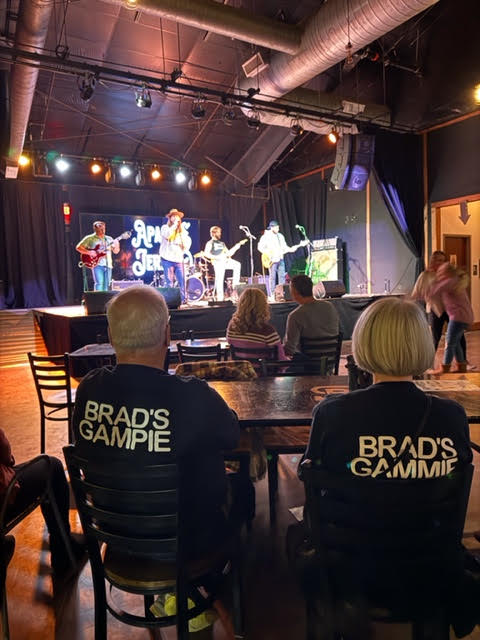
The mind worm of the refrain was a likely result of yesterday’s conversation that turned stressful with my daughter, Stacey. We are in Tennessee with her spending time with our immediate family for a couple weeks on our way from Michigan to Florida. Our older grandson’s band had a music gig on Friday evening and we were proud to be Brad’s Gampie and Brad’s Gammie at Hop Springs as Apache Jericho rocked the house.
Brad is the lead vocalist. He has been writing music and performing for years. If you have a premium account with Amazon or Spotify you can shuffle songs by Apache Jericho.
With my fingers on the keyboard now, I am listening to “Essential Grief Education” with Meghan Riordan Jarvis, author of Can Anyone Tell Me? As I hear her speak about the synapses that are ministered to when you use pen or pencil and paper or work with words, I know the value of The Yellow Brick Road to save my sanity.
Thoughts of time spent riding bikes for miles and miles with Fred following the death of my friend, Linda, this summer allows the three key actions suggested by Jarvis to leap onto my page:
1. You need to take a walk. You need to move. EVERYDAY.
2. If you can tolerate connection, do this with with another person. They can walk beside you or behind you or in front of you, but breaking the sense of isolation that occurs with loss ad grief is essential.
3. We can work on the story of what we are telling ourselves about what happened.
Meghan continues to remind us while we might never be grateful our loved one died, we do gain gratitude for gifts and growth that come.
Grievers say there is meaning that comes….
The point of loss of rapport came in conversation around the issue of abortion. This issue has trailed behind me, having begun in the 70’s and 80’s when I was a delegate to Annual Conference of the United Methodist Church — a church that is no longer united.
In my earbuds, Meghan is sharing about the importance of asking grievers, “What’s the secret terror that you have since this loss?”
I witness now a secret terror in my central nervous system: John and I are standing in the Holocaust Museum in Washington, D.C., watching white letters scroll across a black screen giving the dates and actions being taken that led from banning a single book to 11 million victims of the Holocaust in Nazi Germany….
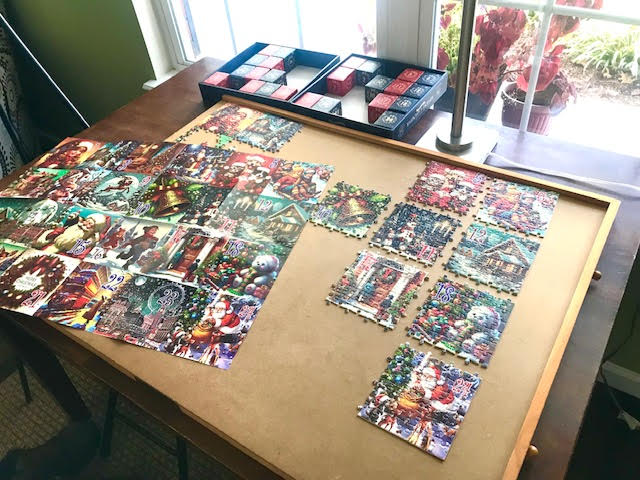
Stacey and I had been working on a jigsaw puzzle when yesterday’s rip in rapport took place and she turned and walked out of the room. Perhaps the puzzle itself holds a clue for us. It is a Advent Calendar puzzle, with the pieces of each section in 24 small, numbered, separated, boxes. I am realizing this puzzle does not feel like fun.
Working this puzzle, it doesn’t feel like we are working together.
Working this puzzle, I don’t like the feeling that things have been artificially segregated.
After Stacey showered and got ready for their evening out, she approached me. I am unable to remember that conversation. That happens with grief. We don’t recall when something happened or how it happened, because what happened is distorted.
I do recall answering a question she had earlier asked me about my beliefs about abortion. I told her the issue of abortion isn’t separate for me from other experiences about life and death. If an adult dies and somehow continues to exist — like her own experiences of loved ones speaking to her (her Grandma Smith and the dutch apple pie recipe or her Uncle Jim about not being a dumb ass) how could that be different for an aborted baby?
I was able to express a wondering about how she had become so black and white in her morality and the concern I felt that the divide in the mind might be too wide to bridge; that being the nature of the mind.
I can feel a tightness in my chest as those words appear on the page.
I am going to ask her if she is OKAY if we switch to a different puzzle….
Anne Braden was a name I did not know, but something about her words resonated deeply in my soul. I share some of that…. envisioning a world that has never existed. I put a lovely THANK YOU FOR NOT SMOKING sign on the door to our home over 40 years ago. Members of my husband’s family refused to come to our home. Admittedly, it was a stressful happening at 4230 Lincoln Avenue.
The prohibition of smoking in public places, in places of employment, and in food service establishments (such as restaurants, cafeterias, food courts in shopping malls, and bars) took effect here in Michigan on May 1, 2010, when the Public Health Code was finally amended.
There are many born in this country after 2010 who have no memory of teachers smoking in schools, doctors (and patients and visitors) smoking in hospitals, and patrons, along with cooks and wait staff, smoking in restaurants.
I am profoundly grateful not smoking in public places is seen now as normal.
According to her bibliography on Americans Who Tell The Truth, all of Braden’s activism flowed from a single conviction: she wanted to live in a world “where people were people,” not members of a particular race or class who were treated better or worse because of it.
Recently I have begun to envision radically new ways of choosing governmental leadership. One suggestion was to have a mutually-agreed-upon criteria for civil servants, and any individual who met that vetting and was willing to serve, would toss his or her hat into the ring. There would be no campaigning, no voting, no parties. At a certain date some random process (maybe similar to the way lottery numbers pop into a vacuum tube) would make the selection. Think of the time and money and energy that would become available for important things.
Our leadership would come from a pool of many who are willing and able to live and serve the world in/from servant leadership.
Anne Braden, a Civil Rights Activist and Writer, was born in 1924 and died in 2006. Anne Braden is best known for a single act: In 1954 she helped a Black couple buy a house in an all-white neighborhood of Louisville, Kentucky. One hundred years from the day Anne Braden was born, and 70 years from the day Anne Braden helped that Black couple buy a home in an all-white neighborhood of Louisville, it is now normal for people all over this country (not just in Louisville) to buy any home anywhere they want to and can afford to live. Regardless of the color of skin.
When I told a friend about envisioning a new civil leadership selection process, he shared an idea a friend of his came up with years ago: A six-year presidential term, with no reelection option. That person saw this as a potential end to a first term serving primarily as grounds for re-election.
Watching “Love, Power and Liberation” I also learned that when much of the world entered pandemic lockdown in spring 2020, Robyn Maynard, influential author of Policing Black Lives, and Leanne Betasamosake Simpson, award-winning author, began writing each other letters — a gesture sparked by friendship and solidarity, and by a desire for kinship and connection in a world shattering under the intersecting crises of pandemic, police killings, and climate catastrophe.
When much of the world entered pandemic lockdown in spring 2020, Robyn Maynard, influential author of Policing Black Lives, and Leanne Betasamosake Simpson, award-winning author of several books, including the recent novel Noopiming, began writing each other letters—a gesture sparked by friendship and solidarity, and by a desire for kinship and connection in a world shattering under the intersecting crises of pandemic, police killings, and climate catastrophe. Their letters soon grew into a powerful exchange on the subject of where we go from here.
Rehearsals is a captivating book, part debate, part dialogue, part lively and detailed familial correspondence between two razor-sharp writers convening on what it means to get free as the world spins into some new orbit. In a genre-defying exchange, the authors collectively envision the possibilities for more liberatory futures during a historic year of Indigenous land defense, prison strikes, and global-Black-led rebellions against policing. By articulating to each other Black and Indigenous perspectives on our unprecedented here and now, and the long-disavowed histories of slavery and colonization that have brought us to this moment in the first place, Maynard and Simpson create something new: a vital demand for a different way forward, and a poetic call to dream up new ways of ordering earthly life.
In Love, Power, and Liberation Lama Rod Owens spoke such wisdom and grace. He says we have to mourn what is happening and there has to be a place for joy. That joy has to become a discipline and a practice. He spoke historical truth about many people who have faced real struggle, even genocide, and how there’s been joy in these moments. He says we have to continue to choose the laughter and the joy and we have to choose community. He says we have to reemphasize our dreaming. He says we have to stay true to the dreams that we have about what we want the world to look like.
He shared Emma Goldman’s saying, “If I can’t dance, it’s not my revolution.”
All of Braden’s activism flowed from a single conviction: she wanted to live in a world “where people were people,” not members of a particular race or class who were treated better or worse because of it.
Perhaps you and I want to live in a different world.
Perhaps many of us want to live in a different world, a world where people are people, a world where joy and laughter and community are a practice, a world where people are people, not members of a particular race, religion, or political party….