Tag: Vesper Time: The Spiritual Practice of Growing Older<

  • Still Waters

    I watched with curiosity as the last thing to slide off my Friday schedule was lunch with Jane Foster. Although it was nine pm, I picked up the phone and called Still Waters Retreat House. Delcy Kuhlman now graciously agrees when I say I will bring my own lunch. She has served as chief cook, bottle washer, gardener, and spiritual director for twenty nine years. I’ve been going there for almost 23 years. And most of the many hours there have been spent sitting in the grape-vine rocking chair looking out at that majestic oak tree faithfully holding the swing and my heart. Now, though, when I look out, everything I see I see as impermanent.

    This does not make me sad. I treasure the moment. Breathing in deeply, this moment melts with all the previous times I have sat here. I witness the past, the present, and the not-quite-yet, with profound peace and reverence.

    “If you want to take a break later, walk back to the house,” Delcy says as she bids me farewell after greeting me and introducing me to, Abi, who has been on retreat all week. I know I will make that walk, and I know I will savor our talk.

    Standing in the hallway chatting, thunder rolls, moving us to Delcy’s den. She flips on the light and we watch the rain and I worry that the sliding door in the chapel was left open until we send a text to Abi asking her to close the door. Then we are present to one another, to ourselves, and to the unseen force that has called us together.

    “I have been doing a lot of process about dying,” I say. Delcy nods her head in agreement, and is slightly distracted as she begins to scan her bookshelf. I mention having just read Vesper Time: The Spiritual Practice of Growing Older, by Frank J. Cunningham. And I tell her about having done the Corpse Prayer Exercise for my birthday ritual in January. About how author, Jarem Sawatsky has written about living with dying from Huntington’s Disease in Dancing with Elephants. She makes notes of both of those books, then pulls The Grace in Aging off the shelf and hands it to me. She is still slightly distracted, telling me she is also looking for The Grace in Living, by the same author—Dharma teacher, Kathleen Dowling Singh. Delcy said she got that one by mistake.

    We search together, and I find it. The Grace of Living is laid beside me on the love seat. Here are notes I took from that precious book about our need to write our spiritual biography, telling the story of our lives from the continuous movement toward awakening:

    The Grace in Living: Recognize It, Trust It, Abide In It by Kathleen Dowling Singh

    When we mindlessly allow attention to be fueled by desire or aversion, no matter how subtle, we sense the self with a distinctive flavor in that moment. The engines of self rev up, gunning for the expression of that particular flavor of reactivity. In doing so, we psychologically remove ourselves from the truth. We separate ourselves from the sacred, the “one taste” of nonduality. p. 30

    We begin to recognize that form, the universe of self, has never for a moment been separate from the sacred formless. Only our conceptions view them as separate. That they could be separate is impossible. p. 31

    It is sweetly empowering to realize our inseparability from the sacred. With this encouragement, we can tenderly assuage our self-doubting and minister to it with less denial, less judgment, and infinitely more compassion. Recognizing that we are already in the divine flow—and always have been—confidence grows. p. 31

    We begin to recognize ourselves as ordinary human beings—a profoundly liberative recognition. We except ourselves just as we are in each moment. We are awakening. We surrender any further need for judgment or pretense. p. 32

    The heart leads us forward with less obstruction and more sanity. The heart is the only containers spacious enough to hold both the overwhelming suffering of the world and the almost unbearable joy of grace. p. 35

    Ken Wilber reminds us that the fires of transformation are not a relaxing hot tub. The work of healing can entail great suffering as we allow ourselves to feel, finally, all that we have rejected, ignored, and stuffed deep inside. Many practitioners experience a dark night of the soul during this time. We break open. This state of brokenness is the leaping-off point for surrender. We’ve exhausted ego’s possibilities and have nowhere left to turn.

    We stay in survival mode until we’ve had enough suffering and—surrendering—wish to see through the causes of suffering. Many people, especially those without a practice, stay in survival mode until the very end of life, when there is no choice other than to let go, surrender, and see Reality as it is. May each of us have the grace to die to who we think we are before who we think we are dies. p. 69

    As I finish The Grace in Living and reach to start The Grace in Aging, I search for Kathleen on the internet. I hold my breath as I come across a blog titled: “Kathleen Dowling Singh, RIP”.

    Gone? How can that be? Her writing is so alive, so real, so vital.

    Suddenly I know anew why I write. And I understand at the cellular level why a spiritual biography is so important.

    Please don’t be surprised by my passing. Everything passes.

    Please don’t discount the dharma (truth) of my life. I won’t live forever.

    Please don’t miss the moments of your life today. They are our Still Waters.

  • Milarepa’s Muses


    I am in a poetry writing group. We are working our way through The Crafty Poet: A Portable Workshop by Diane Lockward. Craft Tip #12 is about the uses of myth. “Milarepa’s Muses” is based on The Non-Duality of Coming to Know the Light Within the Darkness; Age of Kali , a talk given by Aaron on Saturday Morning, December 3, 2016, at a retreat in Seattle. Aaron is channeled by Barbara Brodsky. You can read Aaron’s entire talk at the Deep Spring Center Archives. I have included a clip of just the story of Milarepa at the end of this post.

    Milarepa’s Muses

    Demons on the doorstep
    Demons outside, Milarepa inside
    Duality

    Delighted demons destroying
    Property and Milarepa’s
    Peace

    Always there, those demons
    Doing their demon things
    Determined

    Dogging his footsteps
    Dodging his arrows
    Dastardly

    “Eat me,” mouthed as
    Milarepa puts his head inside the demon’s mouth
    Victory

    The demon disappears
    Light merging with darkness
    Oneness

    Debra Basham 7-17-2018 (WC 53) based on The Non-Duality of Coming to Know the Light Within the Darkness; Age of Kali by Aaron

    It seems one of the most common demons visiting humans is the demon of the fear of death. I just finished reading Frank J. Cunningham’s, Vesper Time: The Spiritual Practice of Aging. On page 131-132, Cunningham writes that when the Dali Lama was asked if he feared death, he replied, “It’s just a change of clothes.”

    Ending the duality and recognizing the truth that death is just a change of clothes is putting your head inside the demon’s mouth and watching the demon disappear.

    The Non-Duality of Coming to Know the Light Within the Darkness; Age of Kali
     
    December 3, 2016 Saturday Morning, Seattle Retreat;
    Combined retreat opening talk and morning instruction with Aaron

    Some years ago, I offered the group at this retreat the second Milarepa practice. Not the serving tea practice, that’s Part 1. First we serve him tea. We get used to the demon. We stop running from or denying the demon. We open our hearts to ourselves and the demon. We serve him tea and say, “Shh, no dialogue. We’re not going to talk, but you may be here. I’ll let you be present.” To let him be present there must be a deep sense of, not your power, the power, when you rest in connection with the light. It is that connection that allows you to permit the demon to sit before you. But there’s still separation: me here, the demon there.

    The second Milarepa practice. He comes back to the area of his cave carrying firewood on his back. As he approaches his home he finds it’s overrun by demons. His first impulse is to grab a stick of firewood. He starts chasing them with one big club. Of course, they’re delighted; they laugh. They were really getting to him! “Look how much anger! Ooo! More! More!” So the more he chases them, the more they take delight in his fear and anger.

    Finally he realizes this isn’t working. He sits, he meditates, he thinks, “What can I do? I’ll send loving wishes to them.” They laugh. They don’t care about his loving wishes. They’re busy destroying his home. “What else can we do? How can we get him more riled up?” and proceed with their destruction. Finally he looks around. He thinks, “maybe they’ve always been here and I just never noticed them before. I’ll just be here and present with them”. Most of them get bored when he’s no longer agitated, and they leave. But there’s one fierce demon with bulging eyes, big teeth, a huge, gaping mouth, and he follows Milarepa everywhere, 6 inches behind him, always right there, sometimes coming around face to face.

    The days pass, the weeks pass. Finally, Milarepa understands there’s only one choice here. He approaches the demon, looks him in the eyes, says, “Eat me,” and puts his head in the demon’s mouth. What happens then? The demon disappears. Why?

    Q: The demon has no power over Milarepa.

    Aaron: Even more than that. Thank you, but one more step.

    Q: Non-duality.

    Aaron: He ends the duality. This is what we’re doing here, not just at the retreat, but this is what your world has invited you to. This is the whole image of Kali, the destroyer, destroying the duality. Fully embracing not only the light, but the darkness. Instead of clinging to the light and in any way trying to push the negative away, as we embrace the darkness and merge the light with the darkness, they dissolve into one. I use the image here of a huge dark cave; if you light one match the whole cave is lit even if dimly. You can’t see into the darkest corners, no. But as soon as there’s light, there’s light. It’s no longer dark.

  • Renewal of Mind, Body, and Spirit

    “Without renewal of mind, there is no transformation.”
    ~Lailah Gifty Akita, Ghana-born PhD student in geosciences, author;
    age not provided at goodreads.com

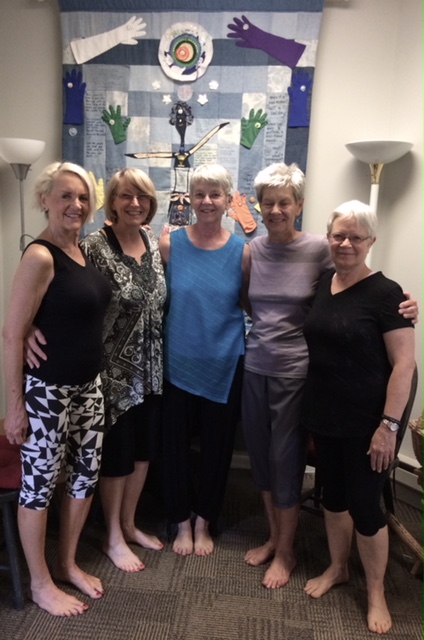
    This opening quotation in a friend’s daily thought really spoke to me. June 16, 2018, I celebrated the birthday of my dear friend and yoga teacher in a small class that meets on Saturday mornings at my office. The five of us are close, not just friends, but more like sisters.

    Left to right: Norleen, Debra, our teacher Kathy, Nancy, and Claudia.

    Let’s just say we are all women of a certain age.

    As women, we share a lot more than yoga, but yoga is something we love. We each have come to yoga for different reasons, at different times, and in different places, but we treasure being together in yoga now because yoga is about renewal of Mind, Body, and Spirit.

    The five of us are beautiful women, inside and out. We have spent well over a hundred years meditating, practicing yoga, and being intentional about our being.

    After an hour of yoga practice, we brewed peppermint tea grown in Kathy’s garden, sweetened with an old fashioned peppermint stick. We ate my nearly world-famous vegan bran muffins, and we were nourished by love and respect and commonality.

    We were infinitely grateful to honor Kathy, who honors us by bringing yoga to our life. Yoga is not just about what happens on the mat.

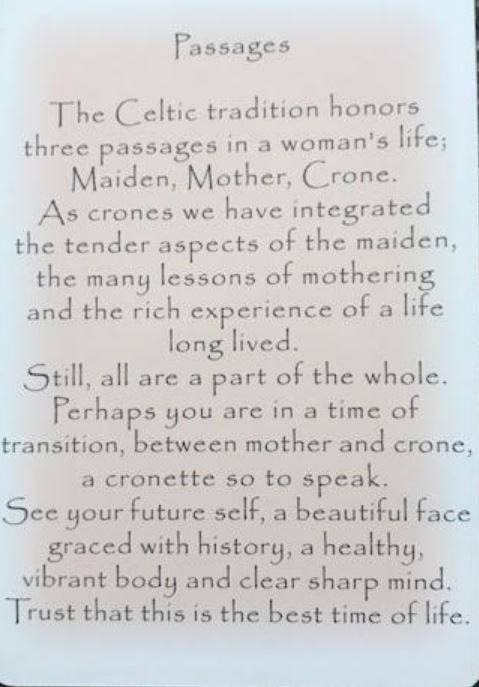
    We each drew a card from the Wisdom of The Crone deck. Kathy drew “Passages.”

    Nancy recently gifted me a copy of Frank J. Cunningham’s Vesper Time: The Spiritual Practice of Growing Older. This book may seem a bit too religious for some, too early for others, and irrelevant to many, but at any stage and especially at our age the wisdom and inspiration is worth integrating because, as Cunningham writes, “… we are in a phase of life that we will not look back on as we do on childhood, adolescence, and adulthood. We do not grow out of this phase.”