Tag: second-arrow

  • Dear Heart

    Several times yesterday I felt great sadness and compassion for my body. This is likely the result of talking to my primary doctor about what I observe related to blood pressure and heart rate. She said the medications are not causing the things I am observing, so it makes her wonder about my heart. I am already scheduled to have a Coronary Artery Calcium Score test done next week.

    The feelings of sadness and compassion for my body are like one would feel for “another” person. Awareness of all that my body has endured, plus a desire to care for it, fills me with great love.

    The “Voice” assures me my heart is healthy.

    The same “Voice” said it has assured me I was done with melanoma, and that has been the case.

    At 2:00 am I received an email from a woman in our dharma study group. She is in her last trimester of pregnancy and she and her husband, their toddler son, and her parents are all ill with Covid. Two of Barbara Brodsky’s sons have tested positive and are quite ill. Another of my dharma buddies is also navigating.

    I pick up crayons and a pen and begin to draw and write.
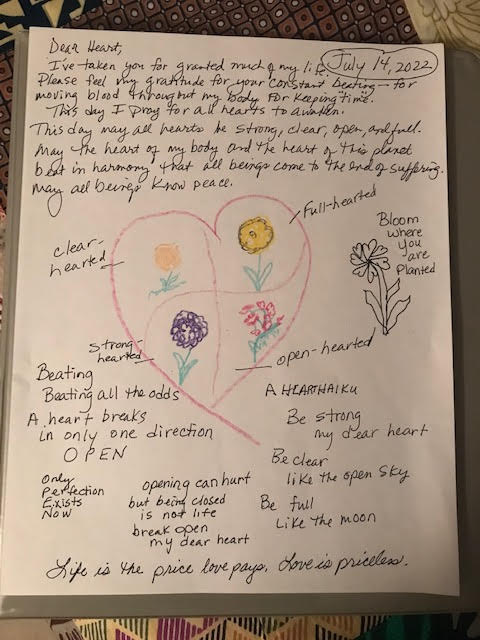
    I draw a four-chambered heart, as observed in The Four-Fold Way: Walking the Paths of the Warrior, Teacher, Healer, and Visionary, by Angeles Arrien. Arrien is a cross-cultural anthropologist. She is a leading expert on native spirituality and shamanism. In The Four-Fold Way, she reveals the four archetypal principles of the Native American medicine wheel and how they can lead us to a higher spirituality and a better world.

    Flowers spring up and I write a haiku (poem).

    A Heart Haiku
    Be strong, my dear heart
    Be clear, like the open sky
    Be full, like the moon

    Opening can hurt
    But being closed is not life
    Break open, my dear heart

    I write about beating. Beating all the odds. And that a heart breaks in only one direction: open. I write a an acrostic poem, in which the first letter (or syllable, or word) of each line (or paragraph, or other recurring feature in the text) spells out a word or message.

    O – Only
    P – Perfection
    E – Exists
    N – Now

    I write a letter to my own physical heart.

    Dear Heart,

    I’ve taken you for granted most of my life. Please feel my gratitude for your constant beating — for moving blood through my body. For keeping time.

    This day I pray for all hearts to awaken.

    This day may all hearts be strong, clear, open and full.

    May the heart of my body and the heart of this planet beat in harmony that all beings come to the end of suffering.

    May all beings know peace.

    Love, Debra

      In a sutra called The Arrow, the Buddha gives a simile. He says arising anger or frustration feels like getting hit with an arrow. It hurts. Tension, pain. If you get hit with an arrow, will you be kind to yourself for being hit with an arrow? As soon as the thought comes up, ‘I shouldn’t have been hit by the arrow. Maybe I wasn’t careful. Why did this happen to me? Something’s wrong with me. I hate this.’ it’s just like getting hit with a second arrow. The first arrow was painful enough. The first arrow you couldn’t avoid, you didn’t see it coming. The second arrow you’re responsible for. And yet to say, ‘I’m responsible, so I am bad and I have to fix it,’ is just a third arrow.
      ~ Daily Quote by Aaron

  • Carpe Diem!

    Gather ye rosebuds while ye may,
    Old Time is still a-flying;
    And this same flower that smiles today
    Tomorrow will be dying.
    The glorious lamp of heaven, the sun,
    The higher he’s a-getting,
    The sooner will his race be run,
    And nearer he’s to setting.
    ~ Robert Herrick

    My fingers have been missing in action from the keyboard as I have enjoyed spending time with a precious friend. We played dominoes, went sightseeing, dined with decadence, and shared about dealing with pain.

    Today I am catching up.

    This is the beginning of the February 6, 2019 daily thought of David J. Bloyd:

    “Memories— the one thing that can never be taken away from us. Make lots of them! “

    —Catherine Pulsifer, Canadian author; age not provided

    wiseoldsayings.com (website)

    ~~~~~~~~~~~~~~~~~~~~~~~~~~~~~~~~~~~~~~~~~~~~~~~~~~~~~~~~~~~~~~~~~~~~~~~
    But be careful…very careful…because it’s just as easy to form a bad memory as it is a good one. I recall a story I read many years ago. A family was on a trip in their car, carefully planned regarding timing and distances, and on-target to fulfill those plans. Their little boy was in the back in his car seat playing with his favorite stuffed toy. His window was open to give him fresh air. Suddenly he cried out that his toy was gone. The father asked where it went. “Out the window”, the boy replied. Now the father had three choices: Chew the little boy out and keep driving; just keep driving and let the little boy suffer the loss; stop, turn around, and go back to look for the toy. He chose the last option.

    Later, when with friends, the wife told the story. One of the friends asked the man “Why? Why did you ruin your schedule over an inexpensive teddy bear?”

    The father smiled and said “Because the toy was his favorite.”

    Now why is that important?

    Because whatever choice he took, it would have created a memory for the little boy—either a sad one or a marvelous one. We have future memories in our control. Whatever we do today we’ll re-live tomorrow.

    Reliving pleasant things is very pleasant. I have been doing some of that around my last week. Reliving unpleasant things can be even more unpleasant than the experience itself.

    My friend, Sheilana Massey, wrote Peace Has No Space for Memories. The book encourages us to live in the moment of right now, without dragging in the past or living in the future. She says we can live with Love for what is, not for what was or what will be. From this space our planet will move into Peace, Love and Joy for all Creation.

    The Buddha taught that we cannot prevent pain, but we do not have to suffer. “In life, we cannot always control the first arrow. However, the second arrow is our reaction to the first. And with this second arrow comes the possibility of choice.” (A search for ‘the second arrow’ will yield lots of pages, or check out How the Buddhist metaphor of ‘the second arrow’ can help you to be nicer to yourself.)

    This is often summarized as, “Pain is inevitable, but suffering is optional.”

    My friend is enduring a lot of pain.

    Amidst the pain, however, she is ecstatic about her new life with her new husband. She eats with enthusiasm. She loves music. She laughs a lot.

    Whatever we do today we’ll re-live tomorrow.

    Gather ye rosebuds while ye may… Cease the day!

  • “If” In Life

    IF IN LIFE

    There will always be a ‘lie’ in believe,
    An ‘over’ in lover,
    An ‘end’ in friend,
    An ‘us’ in trust,
    And an ‘if’ in life.
    —author’s name not provided

    The Boehner aphorism, “If ‘ifs’ and ‘buts’ were candy and nuts, we’d all have a merry Christmas,” was coined by the Dallas Cowboys quarterback, Don Meredith, who later became a sports commentator for the TV show Monday Night Football in 1970. But it is not just football that realizes there is an “if” in life.

    This week, Stacey and Doug let the family know they will not be going on their Caribbean cruise on their boat (“The Lady Gail”) this October. This decision is partially the result of Doug’s Dad’s having had a toe, foot, and leg amputated due to diabetes complication, and partially the result of Doug’s inside-and-outside cardiac ablation scheduled for Tuesday, May 29. We are all feeling disappointment.

    As a result, I am working on a clergy column about the importance of not letting disappointment digress into despair. I will include in that article the Buddhist story about the second arrow in which the Buddha asked a student, “If a person is struck by an arrow, is it painful? If the person is struck by a second arrow, is it even more painful?”

    The teaching goes on, “In life, we can’t always control the first arrow. However, the second arrow is our reaction to the first. This second arrow is optional.”

    The Buddha’s second-arrow teaching is most often used as a demonstration that while pain is inevitable, suffering is optional.

    This week I had a conversation with a college sophomore who has recently experienced some difficulty with the loss of a relationship. His own words were, “I feel like shit.” We understand that but also know his life is not over. Experience shows how rarely a life-long union occurs with the partner in our early relationships. These moments of loss are rich times for learning about ourselves, preparing us for what is yet to come.

    In some ways, Stacey and Doug (and all of us) are going through a loss similar to this young man’s. I was joyfully anticipating almost a month with Stacey in Florida in December while Doug was taking the boat over open water from Florida to the British Virgin Islands. While their current plan is just to postpone their trip one year, we all know there will always be an “if” in life.

    I was able to hear the truth as I told this young man it is not something we get over, but loss is something we get through. His ability to feel disappointment without the second-arrow of discouragement in the current situation will change the rest of his life. This is true for all of our “if’s” in life. Trust is important for us: for Stacey and Doug and their kids, and for John and me.

    Jeremiah 29:11-13 from “The Message”

    “…I know what I’m doing. I have it all planned out—plans to take care of you, not abandon you, plans to give you the future you hope for.

    12 “When you call on me, when you come and pray to me, I’ll listen.

    13-14 “When you come looking for me, you’ll find me.

    “Yes, when you get serious about finding me and want it more than anything else, I’ll make sure you won’t be disappointed.” God’s Decree.
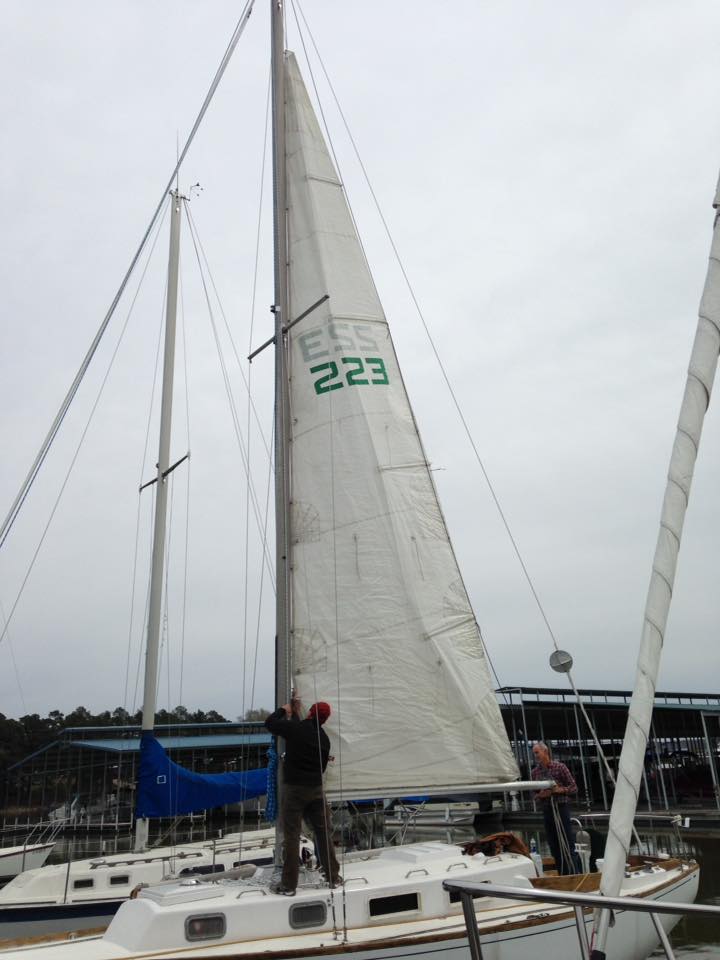
    Doug’s putting up the main sail on The Lady Gail in April.