but it represents your behaviors
and patterns from your past.
~ Daily Om
My sister and I just learned a childhood friend and neighbor took his own life. We had recently ended up living near one another again after all of these years. I instantly felt a profound sense of loss. That motivated me to do some journal writing about what is real. “V” is for inner voice.
D: What would you have me know?
V: Know as real whatever you are experiencing. Sadness? Shock? Loss? These are your real experiences. Just don’t confuse them with True.
You said you had read once that suicide is a permanent solution to a temporary emotion. Can you see how every feeling state is just that?
D: Yes, emotions are fleeting.
V: Everything in the conditional realm is fleeting. What lasts?
D: Impact lasts.
V: In what way/s?
D: Impact generates consequences or changes options or dictates choices.
V: Yes, you are describing residual. No moment stands alone. No one is alone.
I felt as though our friend led me to a short video of Rupert Spira answering a question at the end of a retreat about how to come back to a sense of being when going back out into the worldly activity. He began by saying, “You don’t just visit your being, you live there. The peace of your background begins to eclipse your foreground.” He encouraged us to align our external life: where we live, what work we do, and the people we hang out with.
I wondered if my childhood friend having just returned from his summer home here in Michigan to his “real” life contributed to a state of mind that was intolerable. I will likely never know the details, but we all learn from everything we become aware of.
Rupert also spoke about the relationship of suffering and resistance, “You don’t resist suffering because it’s suffering. You suffer because you resist…. ‘I don’t like what’s happening’…. all your suffering consists of that single thought…. Face your experience from awareness. Awareness does not know the meaning of resistance.”
AI generated the following:
-
Suicide is not viewed as a simple choice but as the complex result of suffering and illness. The language used to discuss suicide should be handled with care and respect, focusing on the feelings of those left behind.
When discussing suicide, it is best to avoid stigmatizing language.
Use: “died by suicide” or “took their own life”.
Avoid: “committed suicide,” as this term implies a criminal act.
When comforting a person grieving a suicide, your focus should be on supporting them. Those grieving often experience unique and intense feelings of shock, guilt, and anger. Your presence is the most powerful tool you have to help.
What to say:
“I’m so sorry for your loss. I’m here for you.” This simple and sincere acknowledgment is often the most comforting thing you can offer.
“I don’t know what to say, but I want you to know I care.” It is okay to admit you don’t have the “perfect” words. This is more honest than trying to pretend you understand their pain.
Say the persons name. Referencing the person by name shows that you have not forgotten them.
So, to the family and friends of this friend, I say, “You will be remembered.” For 40 days I will chant for him; until November 13.
“Gate, gate, paragate, parasamgate, bodhi svaha” is the Buddhist mantra found at the end of the Heart Sutra. It translates roughly to “Gone, gone, gone beyond, gone utterly beyond, Enlightenment, hail!”. The mantra signifies a journey across the “other shore” of suffering to the realization of wisdom and enlightenment, or bodhi. Each word progresses the idea of departing the conventional world for ultimate understanding.
This is how Rabbi Rami Shapiro writes about death in “Roadside Assistance for the Spiritual Traveler”:
November/December 2008
What happens when I die?
Where does an ice cube go in a tub of warm water? You are the cube, God is the water. For a while you seem separate from the water, but eventually you melt – you die – and discover that you, too, are water. Have fun being a cube; just don’t forget that all cubes are water, and everything is God.
And January/February 2007
Imagine that the universe is a rope and you, your mom, and all things are knots in that rope. Each knot is unique, and all knots are the rope. When we die our knot unties, but the rope that is our essence remains unchanged: we become what we already are.
Life after death is the same as life before death: the rope knotting and unknotting. The extent to which you identify with a knot is the extent to which you grieve over its untying. The extent to which you realize that the knot is the rope is the extent you can move through your grief into a sense of fearless calm.
For me, the rope is God, the source and substance of all reality. When your mom dies she relaxes into her true nature, and realizes who she always was and is: God. I believe this realization comes at death regardless of who we are or how we life.
In “No Death, No Fear” Thích Nhất Hạnh writes:
The day my mother died I wrote in my journal, “A serious misfortune of my life has arrived.” I suffered for more than one year after the passing away of my mother. But one night, in the highlands of Vietnam, I was sleeping in the hut in my hermitage. I dreamed of my mother. I saw myself sitting with her, and we were having a wonderful talk. She looked young and beautiful, her hair flowing down. It was so pleasant to sit there and talk to her as if she had never died. When I woke up it was about two in the morning, and I felt very strongly that I had never lost my mother. The impression that my mother was still with me was very clear. I understood then that the idea of having lost my mother was just an idea. It was obvious in that moment that my mother is always alive in me.
I opened the door and went outside. The entire hillside was bathed in moonlight. It was a hill covered with tea plants, and my hut was set behind the temple halfway up. Walking slowly in the moonlight through the rows of tea plants, I noticed my mother was still with me. She was the moonlight caressing me as she had done so often, very tender, very sweet… wonderful! Each time my feet touched the earth I knew my mother was there with me. I knew this body was not mine but a living continuation of my mother and my father and my grandparents and great-grandparents. Of all my ancestors. Those feet that I saw as “my” feet were actually “our” feet. Together my mother and I were leaving footprints in the damp soil.
From that moment on, the idea that I had lost my mother no longer existed. All I had to do was look at the palm of my hand, feel the breeze on my face or the earth under my feet to remember that my mother is always with me, available at any time.
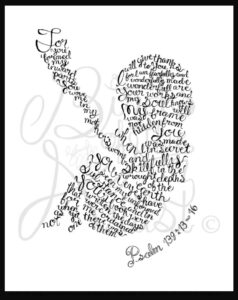
May his family and friends know he is always with us.
May all beings come to the end of suffering.
May all beings love and be loved and know that they are love.
May all beings know perfect peace.
Amen.