Tag: puzzle

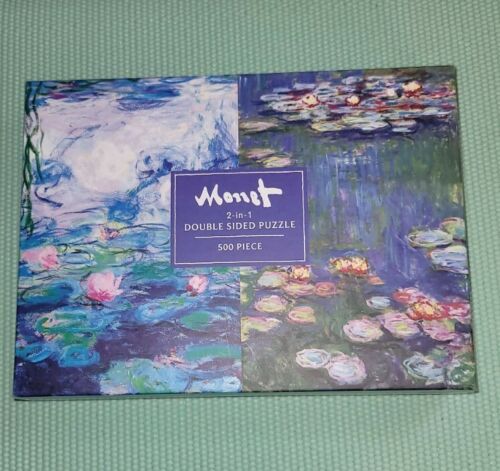
  • Monet Double-Sided Puzzle

    They were visiting with friends and family who all live in Michigan, while wintering in Florida. They had gotten together because their sister-in-law had come for a short visit — the first time of her being in the RV park where she and her husband had wintered together for many years.

    The conversation got around to doing jigsaw puzzles. She said, “A friend sent a Monet double-sided puzzle to us.”

    The puzzle had been sent as a gift following her husband’s heart surgery. The friend who sent it assumed he did puzzles with her because every puzzle was finished by him placing the last piece and posing for a photo.
    When he asked to be reminded which of there friends had sent the puzzle, she replied, “Sue Spitler.”

    “Sue Spitler?!?” their sister-in-law blurted out before continuing to share that Sue had made a donation to the church in memorial of her husband. Not recognizing the donor’s name, she had flagged the donation and when she came upon it again she had searched on line, found numbers for several people named “Sue Spitler” then called the one in Indiana, thinking perhaps it had been a customer of her husband. She felt such a strong desire to know from whom the gift had come.

    Speaking to Sue Spitler, their sister-in-law had discovered Sue was not a customer, and had not known her late husband at all. The donation had been made because Sue wanted to honor the brother of her dear friend.

    Interestingly, although that donation has been made 16 months earlier, their sister-in-law had come across the notation of the mystery donor and had done the internet search and made the call to identify “Sue Spitler” as the donor just three weeks ago …

      Death Is Nothing At All
      by Henry Scott-Holland

      Death is nothing at all.
      It does not count.
      I have only slipped away into the next room.
      Nothing has happened.

      Everything remains exactly as it was.
      I am I, and you are you,
      and the old life that we lived so fondly together is untouched, unchanged.
      Whatever we were to each other, that we are still.

      Call me by the old familiar name.
      Speak of me in the easy way which you always used.
      Put no difference into your tone.
      Wear no forced air of solemnity or sorrow.

      Laugh as we always laughed at the little jokes that we enjoyed together.
      Play, smile, think of me, pray for me.
      Let my name be ever the household word that it always was.
      Let it be spoken without an effort, without the ghost of a shadow upon it.

      Life means all that it ever meant.
      It is the same as it ever was.
      There is absolute and unbroken continuity.
      What is this death but a negligible accident?

      Why should I be out of mind because I am out of sight?
      I am but waiting for you, for an interval,
      somewhere very near,
      just round the corner.

      All is well.
      Nothing is hurt; nothing is lost.
      One brief moment and all will be as it was before.
      How we shall laugh at the trouble of parting when we meet again!

  • Rough Edges

    February has long been celebrated as a month of romance, and St. Valentine’s Day, as we know it today, contains vestiges of both Christian and ancient Roman tradition.

    A few days ago (asking if we are to pursue having Dr. Deutsch be John’s cardiologist) I drew The Lovers Osho Zen Tarot: It is time to refresh your mind and heart and the pure fragrance can spread.

    The idea of a refreshed mind and heart spreading its pure fragrance is somewhat foreign for a lot of us. Much (if not most) of the time, humans live from moment to moment on autopilot. I often observe myself reacting out of habit rather than from awareness and presence of mind.

    Nonviolent Communication training evolved from Dr. Marshall B. Rosenberg’s quest to find a way of rapidly disseminating much needed peacemaking skills.

    Growing up in an inner–city Detroit neighborhood Dr. Marshall Rosenberg was confronted daily with various forms of violence. Wanting to explore the causes of violence and what could be done to reduce violence, he chose to study clinical psychology and received his Ph.D. in Clinical Psychology from the University of Wisconsin in 1961. In 1966 he was awarded diplomat status in clinical psychology from the American Board of Examiners in Professional Psychology. (See About Marshall B. Rosenberg)

    Nonviolent communication creates a space for attention and respect in every moment.

    This was all very much on my mind as Stacey and I accompanied John on one of his cardio rehab walks a few days ago. We went by one of the neighbors where a big party was happening. Cars and carts, bikes, and people everywhere.

    As we went by, Stacey almost touched the guy who lives there. She called out, “I thought you were going to hand me a beer!”

    I reacted.

    I said I would prefer not to engage the guy who lives there. I asked if she had noticed the 3×5 foot “Come and Take It” flag flying on his golf cart. The flag has a picture of an M4 AR15 machine gun on it.

    She said I was judging.

    I was.

    Nonviolent Communication teaches a lot about being able to observe without judging. The four foundations of NVC are:

    Observe without judging. …
    Express feelings. …
    Express and clarify your needs. …
    Express specific requests based on your feelings and needs.

    Stacey has a carry permit. She is a staunch “Second Amendment Advocate.” (Her words! She changed it to second-amendment supporter.)

    Interestingly, one of the most powerful lessons of life reveals itself for me as Stacey and I are doing jigsaw puzzles together. WE SEE THINGS SO DIFFERENTLY.

    Our most recent puzzle demonstrated these differences and the COLLECTIVE strength that grows from them more clearly than any puzzle we have ever done together.

    There were some fascinating “odd” shapes.

    Very complex, very interrelated, very unique.


    It was challenging.

    It was very unique in that the pieces did not connect in a traditional way, they would just rest against each other.

    Stacey was challenged in the areas that were more landscape in style; I was challenged in the areas where she would say, “This is the cat,” and I was not even aware we had a cat in this puzzle! It would often take a half-dozen pieces to be assembled around a unique piece before it was clear where that piece itself went.

    Humans are very complex, very interrelated, and very unique.

    I can’t help but dream of our collective humanity being able to raise our consciousness sufficiently that we smooth our rough edges so our pure fragrance can spread….

  • One Piece at a Time

      one breath at a time
      letting it all go again
      heart breaking open

      how many times now?
      an eternity of time
      one more breath dear one

      one more breath again
      what more can one do than this?
      eternity now…

      ~ A Haiku by Debra Basham February 4, 2021

    Just prior to this haiku coming through, I had written in my journal: Find the space within that grasps at resolution. You can see it so clearly in others. Release judgement around that. Breathe space into your body.

    Listening to Tenzin Wangyal Rinpoche speak about Healing with Form, Energy, and Light: The Five Elements in Tibetan Shamanism, Tantra, and Dzogchen , I was again fascinated by the connection of breath, mind and body. In part one of the recorded talks, he gave a short guided breathing exercise that begins on the exhale. (See all of the talk at Healing with Form, Energy and Light.)

    …. Just breathe out. Exhale any tensions or discomfort that you are feeling in your body, that you are feeling in your breath, or that you are feeling in your mind. (He directs you from the outer (body), to the inner (breath), and then to the sacred (mind).)

    Be aware of your body; the stillness of your body, as you continue to breathe deeply. Be aware of your silence; not speaking, feel the silence; much better to feel the silence than just being quiet. Connect with that silence. Awareness is much better than just being silent. Be aware of the spaciousness of your mind; rest in the space of your open mind.

    Every day I learn of someone who is experiencing depression or anxiety. Many equate those emotions to the many months of the pandemic and the loss of familiar activities. When I feel my mind spinning, putting together jigsaw puzzles helps me to be present with my body, breath and thought.

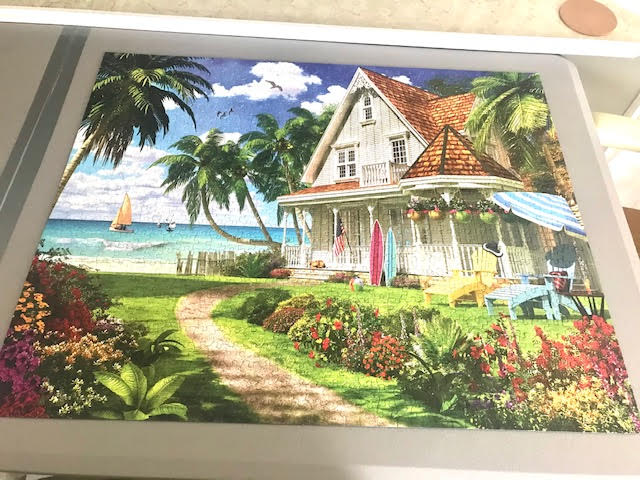
    I put together this 1,000 piece puzzle in one day!

    You might appreciate part or all of Robert Waldon’s take on using affirmations to clear the mind and release tension in the body.

    Affirmation Basics

    The mind is the driving force in determining our experience in this world.

    Affirmations are meant to “show up” any limiting beliefs so they can be erased or deleted, leaving us with a “clean slate”, in a state of health and wholeness—physically, mentally, emotionally and spiritually. They clear unconscious programming that tends to guide our thoughts, feelings and behavior.

    The purpose of affirmations is to erase from the mind all negative thought forms or beliefs which we have falsely learned. Thoughts of limitation, lack and littleness are released and replaced with thoughts of freedom, abundance and magnificence.

    SEEING THE BEST IS SEEING THE TRUTH.

    Do not focus on what is not working. Just recognize where you are “off purpose” by lack of joy experienced, then focus on more joy.

    Every thought creates a result. Negative or fearful thinking creates a negative life experience. Positive or happy thinking creates a good life and happy outlook. Some of both may create a neutral or conflicted effect on our life experiences. Negative experiences can be changed as a result of consistent positive thinking.

    My favorite way to do affirmations is to divide the lined page down the middle.

    The affirmation is written on the left side and your mind chatter or contradictory thought is written on the right side. Then cross off the negative.

    Continue writing the affirmation 20 times and listen for the resistant thought after each one. 20 times daily for 14 days or until there is no resistance.

    They will always feel like a lie in the beginning and you may find great resistance to doing them! Things may change dramatically, so be prepared to notice big difference.

    Writing, speaking and hearing us say the affirmation aloud clears the false beliefs through our sense of sight, sound and touch.

    It is essential that we keep writing and saying the affirmations until there is no longer resistance to the empowering beliefs.

    Remember: Affirmations are not to be used to develop a new belief, but only useful to clear false limiting programs.

    Once there is quiet, clarity and no resistance, we are complete.

    LIFE WORKS WHEN WE ARE WILLING TO DO THE WORK.

    Visit Robert Waldon at Reunion Center for Counseling, Healing and Growth.

    How do you live life? One breath at a time.

    How do you put together a 1,000 piece puzzle? One piece at a time….