Buddhist philosophy offers a list of eight worldly concerns (Eight Worldly Dhammas) that lead to suffering. We pursue pleasure, fame, gain, and praise while avoiding pain, insignificance, loss, and blame. They are laid out in pairs so, like two ends of a stick, you cannot pick up one without also picking up the other.
In Essence of the Dhammapada, The Buddha’s Call to Nirvana, by Eknath Easwaran, we learn that ‘The best thing is not to say either “I’m all good” or “I’m worthless; I’m no good.” The best thing is not to think about oneself, not talk about oneself, not dwell upon oneself at all — to be neither overconfident nor self-deprecating.’
We have a friend who is always complimenting his wife by putting himself down. He does it by making self-deprecating jokes. A few days ago I asked him if he would want one of their grandchildren to do that. He got that. It is so subtle, this being critical of oneself, especially humorously so.
I remember well Betty Lue Lieber and Robert Waldon telling us how our every action is teaching the world. Sri Ramakrishna says, “If you go on saying you are a sinner, you become a sinner.”
I sure had that insight last evening.
People who are dominant on the visual side are very picky and can always find ways to improve things — ways that something could have been better. This reminds me of our time in Florida. Larry loved being out in the screen room. Linda could not go out there with him because the wicker love seat was too short for them to sit on together for her to put her legs up. I was compelled to find a way for them to enjoy being out there together. Dominant visuals are usually sensitive people who do our jobs very well because we are great at adapting and creating something new, but we can be in danger of not getting over things and often get stuck over-analysing the past.
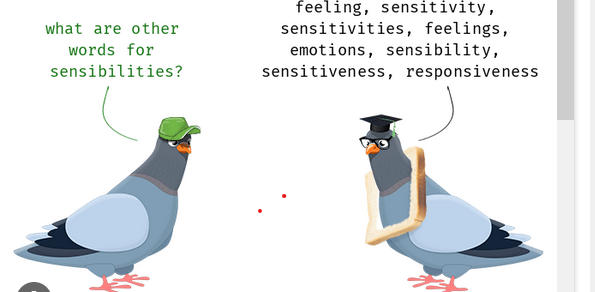
When we play cards I like the cards to be placed right side up, in order, and well-spaced. I totally know this is not a big thing, except that it is for me. In our group, I am clearly the only one who cares and as a defense mechanism, I had developed a self-deprecating manner of saying, “Its my sensibilities….”
According to the Oxford Dictionary the official meaning of “sensibility” is a person’s delicate sensitivity that makes them readily offended or shocked; the ability to appreciate and respond to complex emotional or aesthetic influences; sensitivity. True confession: If I walk into a room and a picture is hanging on the wall crooked, I will notice it. In fact, it is difficult to get my mind to notice much of anything else. Many times I have straightened a frame in a public place, but it is not about the frame. It is about making space within myself to be at peace.
I am seeing this all with deeper insight and compassion after last night’s hissy fit when I shoved the cards to the center of the table and let the shuffling be done by smearing the cards around and around. That was not at all something which fit well with my “sensibilities” but it is certainly ground for the beautiful practice of metta.
This morning’s Daily Aaron Quote:
When you do metta, you’re not trying to generate some kind of altered space. You’re not trying to force the heart open or create special kinds of moods or ways of being that you can’t sustain out of the metta practices. Metta is a way of taking off a blindfold, so to speak. It’s as if you’ve been walking around with very heavily shaded sunglasses and the whole world looks dark. There’s a certain appearance to it, and you begin to believe that’s how the world really is. It only takes a moment to lift off the sunglasses and see the true colors. When you put the sunglasses on again, you know you’ve got sunglasses on. You know that’s not the color the world really is. ~ Aaron
Sadness sits high in my chest and tears lie very near the surface as I put my sunglasses back on and release a lifetime of tension. I pray the great prayer: May all beings come to the end of suffering. May all beings love and be loved. May all beings know perfect peace.
Feeling, sensitivity, sensitivities, feelings,
emotions, sensibility, sensitiveness, responsiveness.