Tag: matters of life and death

  • Aphorisms: You Already Know

    “In the deep end, every stroke counts.”

    “Best not flirt with disaster, lest it decide to commit.”

    “Take two opposites, connect the dots, and you have a straight line.”

    These are a few of the pithy wisdoms included in Where Epics Fail, an upcoming book of aphorisms from Egyptian-American poet Yahia Lababidi, who also said, “Poets, thinkers and artists do not really teach, but remind us of what we already know.”

    This was certainly the case on Sunday, May 21, 2017, when I was honored as guest minister at St. John’s UCC church in New Buffalo, Michigan. The title of the sermon was, “The Light that is You.”

    I opened with a story from way back in the days of full-service gas stations, about a minister who waited in line to have his car filled with gas just before a long holiday weekend. The attendant, a member of the church, worked quickly, but there were many cars lined up ahead of the minister.

    Finally, the attendant motioned the minister toward a vacant pump. “Reverend,” said the young man, “sorry about the delay. It seems as if everyone waits until the last minute to get ready for a long trip.”

    The minister laughed and responded, “I know what you mean. It’s the same in my business.”

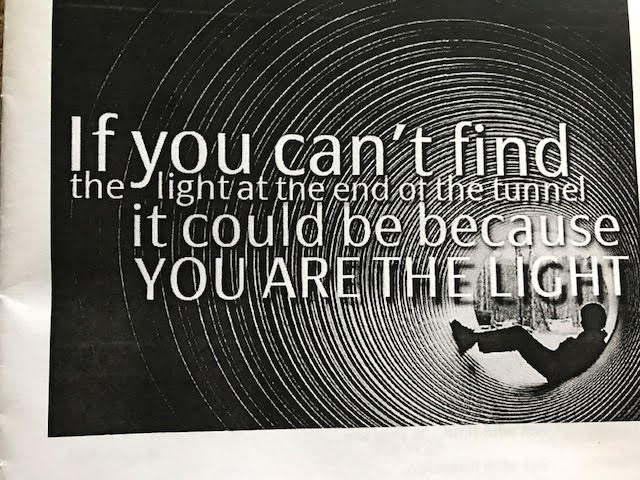
    In the perfect style of aphorisms, the sermon was summed up by this wonderful image on the bulletin cover, selected by Sandy Orange:
    I was blessed to share the work of some wonderful writers, including Zan Lombardo’s poem “EVERYTHING IS INDEED REACHING OUT TO EVERYTHING ELSE” that is done in calligraphy along the bottom of her amazing 30-foot watercolor (See: Three Sylables), and “Social Ethics,” a poignant opinion article by Kathy Zerler which had recently been published in our local newspaper.

    Confessing that I have already created my own eulogy so I can feel honored while I am still here living this life, and to save my loved ones from having to work to do it when I transition, from that I shared “When I’m Gone,” a poem by Mrs. Lyman Hancock, and “Do Not Stand At My Grave And Weep,” written in 1932 by Mary Frye.

    Kathy, my sister-from-another-mister, was with me at church on Sunday, so she got to hear me read her piece. Following the service, Kathy blessed me with the most delicious lunch at Pierre Anne Crȇperie. An authentic French restaurant in a charming Victorian home has been there for 19 years waiting for me to discover it. I am still feeling the lingering effects…

    From the sermon:

    Our lives live on. Our lives are important. Children watch how we live. And children watch how we deal with death. We can live in ways that teach children death is not the absence of goodness, nor the absence of beauty. Perhaps life and death can each be seen as the place where true beauty can be known.

    Death is the only inevitability we all face.

    It seems only fitting to close this blog with another powerful aphorism that reminds us of what we already know—this one found on the St. John’s UCC web page:

    Never place a period where God has placed a comma…

    Can I get an AMEN to that?

  • Love and Affection

    Untitled
    by Ryōkan

    It is not that
    I avoid mixing
    with the world;
    but I do better
    playing alone.

    This poem was excerpted from Sky Above, Great Wind: The Life and Poetry of Zen Master Ryōkan (page 2). It was translated by Kazuaki Tanahashi.

    What I found most fascinating about Ryōkan (1758-1831) is not that he lived much of his life as a hermit and a beggar, or that in spite of never heading a temple or monastery, he is considered one of the three giants of Zen, and has become one of the most popular poets in Japanese history.

    Something inside me was moved by his words because I understand them. Some days you’d like to tell your boss off, yell at your beloved, or run away from it all. That’s when you have to take a breath and remember what you truly want.

    Because April is National Poetry Month, our Pine Island Poetry Meet has no specific assignment for 27 April. We are inviting our muse to have fun. As a tribute to my knowing I am the only barrier to my own happiness, I am sharing “Laid to Rest,” an Insult Poem.

    NOTE: AN INSULT POEM OFFERS A WAY FOR THE POET TO EXPRESS ANGER WITHOUT ENGAGING IN A TOTAL SNARK FEST; THE MAIN HALLMARKS OF AN INSULT POEM ARE HUMOR AND EXAGGERATION. INSULT POEMS DO NOT GENERALLY DEAL IN UNIVERSAL THEMES—THEY ARE PERSONAL AND ARE DIRECTED TO A SPECIFIC PERSON OR GROUP. HOWEVER, THESE POEMS ARE ARTISTIC IN THAT THEY EMPHASIZE THE POET’S VERBAL SUPERIORITY WITH WORDS (AS OPPOSED TO DOWN AND DIRTY FIGHTING AND NAME-CALLING).

    Laid to Rest

    You think you’re so smart
    You think you’re so wise
    The truth is your blindness
    Can be seen in your eyes

    You hide behind intellect
    Totally failing to feel
    Cast your net of blame
    Miss the chance to be real

    You open your mouth
    And close down your heart
    You wax eloquently on
    Playing your part

    Someday maybe
    you’ll see
    Beauty so near
    lurking in me

    But whatever may come
    As the years pass us by
    Too swiftly for most
    Gone in the wink of an eye

    For now I forgive me
    for not giving you
    the space to be
    the freedom to do

    Our past is now gone
    a shadow at best
    too soon, my dear friend
    we’ll both be laid to rest

    Debra Basham 3-21-2017

    I recall the day I stood in my kitchen and spat out an announcement: “I wish I could just run away!”

    My husband looked straight ahead and calmly replied, “What keeps you from doing that?”

    Tears filled my eyes and spilled out onto my cheeks. “I cannot think of anywhere I can go that I will not be there.”

    I loved reading that as an old man Ryōkan fell in love with a young Zen nun. She became his student and the poems of his later period are influenced by his affection for her.

    I’m glad he recognized there is something better than playing alone. I am glad he chose love and affection….