Tag: mantra

  • Mantra for Handling Strong Emotions

    Following some online sharing, she emailed a Mantra for Handling Strong emotions to a friend who lost her husband 6 months ago, had her home damaged by a hurricane, and is now feeling a lot of fear.

    Less than ten minutes later she received a voice mail message from the woman who had shared the Mantra with her originally a few years ago! That woman was in a rehab facility and was asking for the Mantra to be emailed to another friend.

    The Mantra was composed by the Vietnamese monk Thich Nhat Hahn, who is known as a philosopher, teacher of peace, and all things positive, and obviously, LIFE is bringing that information forth for all who can benefit from it at this time.

    Here it is, along with the original notes from the woman who shared it with me:

    Make sure you physically “BREATHE IN” or “BREATHE OUT” at the appropriate place when reciting each line of the mantra; as the actual breath in or out is part of activating the Energy. Use it, every time the emotion arises again, because you are changing how you react to that emotion. It works.

    The “live word” of the Mantra replaces any “strong emotion” being worked on; with the appropriate feeling (Fear, Anger, Anxiety, Impatience, Blame, etc.). I will do the example with fear. Also remember that sometimes anger is an unknown component of the fear that a person is holding, because they are not able to control the fear,…. or Fix it.

    ” Breathing In, I’m aware of the fear,

    Breathing Out, I smile to the fear (yes, these are the appropriate words);

    Breathing In, I recognize fear as Energy,

    Breathing Out, I express Gratitude for Energy;

    Breathing In, Energy and Fear are Power,

    Breathing Out, I can safely hold Power;

    Breathing In, Power supports Wholesome Change,

    Breathing Out, I Invite That, which is for The Highest Good! ”

  • Grief Journey

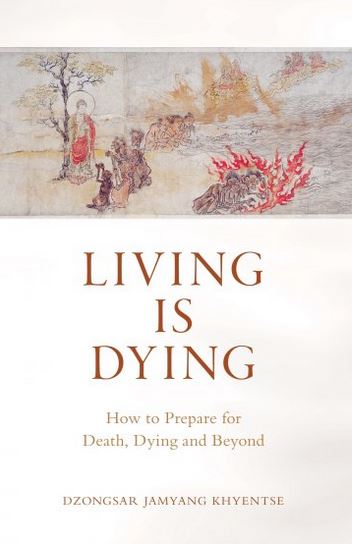
    One of the women at Grief Journey yesterday said she reads everything she can about death. For her, this interest was triggered by the passing of her husband. This morning I received an email message about this book:


    Another woman shared yesterday how her 99 and 1/2 year-old father is still wanting to delay talking about or preparing for his death. Just this past year she was able to get him to update his will. Her mother (who passed 30 years ago) was still listed as the beneficiary….

    From the promotional listing about Living with Dying:

      Whether you know you only have a few months to live or think you have your whole life ahead of you, death is a reality that will have to be faced sooner or later. And as far as the Buddhist teachings are concerned, the sooner you face it, the better.

      No matter how rich, well-connected, famous, intelligent, talented and compassionate a person may be, no one can avoid death. Yet how many of us believe death will happen to us? Or wonder what dying will be like? Or imagine what comes after death? Death is certain and inescapable, so wouldn’t it be sensible to at least inform ourselves about an event that we have no choice but to experience?

      In Living Is Dying, Dzongsar Jamyang Khyentse presents us with everything we need to face death calmly and confidently. Each stage of the dying process is described in detail, along with clear, practical advice about how to guide the dying through the bardos and into the next life. Rinpoche also addresses many common questions, such as: How honest should we be with the dying? How should we talk about death to someone who has no spiritual beliefs? How do we help someone who is already dead?

      Regardless of your spiritual preferences and beliefs—or lack of them—if you are coming to terms with the imminent death of a loved one, your own death, or if you work with the dying, Living Is Dying will help prepare you to meet death consciously, soberly and with a mind full of compassion.

    My new mantra: “May all beings prepare to meet death consciously, soberly, and with a mind full of compassion.” This seems to guide us to a life of compassion.


  • Common Sense: Common Good

    Just when all the chips are down,
    the chins should be up.

    ~ Neale Donald Walsch

    This morning I could feel a subtle pull to look at media, but everybody knows as soon as a winner of the Presidential election is resolved, that news will be widely known. So, why participate in any of the drama?


    Yesterday morning, during the post-election 24-hour meditation event Deep Spring Meditation Center was hosting on Zoom, the fifty-fifty nature of the polarization of our country came up. I asked Barbara about the information SCS calls the Drama Triangle, Cognitive Triangle, and Transrational Pyramid.

    Here is a section of Aaron’s response:

      We are in the midst of a major shift in consciousness on the earth. The loyal opposition is pushing the negative polarity as much as they can. Knowing that this time was coming on Earth, not only old souls have come, to support the transition, but also, strongly negatively-polarized souls have come to try to defeat this transition, to hold the earth into the lower density.

      This is playing out on all the spheres and on all the levels including, of course, the human level. You are not pawns in some game of chess. You have enormous power. You have advisors on the spirit level, but you humans are the ones that can control whether, when, and how this transition will happen.

      Along with those of you who are of a much higher consciousness, there are those who are of high intelligence, with a lot of power and understanding of power, but with intention to use that power in service to the self. This is really what this shift is about—power in service to self, or power in service to all beings.

    The Roman games come to mind. Roman games, called ludi, were probably instituted as an annual event in 366 BC. Might common day sports be the current iteration? Or perhaps politics? Red, white, green and blue teams inspired great loyalty. Wondering if the red and blue of the political parties somehow also originated with the Roman games.

    In 532 AD rioting sparked by the disputes of chariot fans destroyed half the city of Constantinople!

    Augustus only banned fighting to the death due to a shortage of gladiators. It has been estimated that 500,000 people and more than 1 million animals died in the Coliseum, Rome’s great gladiatorial arena.

    Human history is rife with dark times.

    Dagnabbit, we have more common sense to use for the common good!

    One source attributed ‘dagnabbit’ to Elmer Fudd. His twisted version of “dang rabbit” was sputtered while stomping his foot on his hat, after the rabbit that always outwitted him when he was hunting did it again.

    In The Long Linguistic Journey to ‘Dagnabbit’ linguists say humans are afraid of speaking the True Names of enemies so we create taboo deformations. My grandmother would say flitter, in the exact same situations my dad would say $*@#….

    All too often, people go through life being cautious in the name of being careful, when it is, in fact, a matter of fear. Moving ahead boldly is a better indicator of self-assurance and has a much better chance of ending in success. ~ David J. Bloyd; MS, CMP Emeritus

    One of my dharma sisters shared a mantra composed by the Vietnamese monk, Thich Nhat Hanh, known as a philosopher, teacher of peace, and all things positive. The mantra loosens the grip fear can have on you.

    While silently breathing in, say the first line of the two-line phrase; while silently breathing out, say the second line of the two-line phrase:

      Breathing In, “I’m aware of the fear,”
      Breathing Out, “I smile to the fear;”
      (Yes, these are the appropriate words!)

      Breathing In, “I recognize fear as Energy,”
      Breathing Out, “I express Gratitude for Energy;”

      Breathing In, “Energy and Fear are Power,”
      Breathing Out, “I can safely hold Power;”

      Breathing In, “Power supports Wholesome Change,”
      Breathing Out, “I Invite That, which is for The Highest Good!”
    F.E.A.R. (false evidence appearing real) may be the true name of humanity’s only true enemy, but fear has myriad names: greed, anger, cruelty, vengeance, hatred, bigotry, sexism, racism, impatience, insecurity, shame, blame, ignorance, meanness. The list is long.

    For sure, common good is common sense….

    Breathing In, “Power supports Wholesome Change,”
    Breathing Out, “I Invite That, which is for The Highest Good!”

  • Overcoming Addiction

    Start by doing what is necessary,
    then do what is possible,
    and suddenly, you are doing
    the impossible.
    ~Francis of Assisi

    “Addiction, it has been said, starts in pain and ends in pain.” This is the opening line in the Editor’s Note in the January, 2018, edition of GUIDEPOSTS. The title is ‘Overcoming Addiction.” The entire edition is dedicated to the hope of recovery that calls to every addict and the people who love them.

    I am no stranger to addiction. My dad was an active alcoholic throughout my childhood. I am so grateful for his sobriety that came after my marriage and remained for the rest of his life. Grateful my daughter and grandchildren knew him in his sobriety.

    Last evening we were with some friends. This past week has been about her facing her son’s alcoholism. Several times during the evening I would be aware of the smell of alcohol. No one else could smell it, but it was obvious to me. Eventually I said, “It must be my dad.”

    Richard Rohr, an American Franciscan Friar ordained to the priesthood in the Roman Catholic Church, published a podcast titled “Contemplation and Action on the Road of Recovery.” Rohr’s message begins with the radical truth that we are all addicted. He says the universal addiction we share is our addiction to our way of thinking. He says, “Literal-ism is the lowest level of meaning, the least level of meaning. Literal-ism gets you nowhere.”

    Whether taking something personally, literally, or insisting our way is the “right” way, addiction to our way of thinking is one of the most important things we can choose to give up. What would that be like? Recovery.

    Recovery is simply this: union with reality.

    Overcoming addictions is simply this: union with reality.

    Addiction is anything we know is not good for us but we do it anyway. So how do we change this?

    Here is a poem I wrote on September 25, 2017.  It is titled ‘Addiction’s Daughter.’

    His blood shot eyes told the story

    Her words a sloppy slur

    The arguments, lies, disappointed children staring

    wistfully out into space


    Alcohol’s real name is Satan

    Fermented devil Scotch

    And pray tell how one can in his right mind call it smooth

    a true velvety swindler


    Our broken dreams lie there shattered

    Memories all scattered

    Perfection in work and play disguising inward scars

    all weeping done in silence

     
    All weeping is done in silence in addiction. It is important we speak honestly. It is important we choose wholesome actions that invite recovery. It is important our awakened heart is capable of being present for our own suffering and the suffering of others.

    I have found the practice of Tonglen helps to awaken the heart.

    A Variation on Tonglen (receiving/giving) Meditation

    (Instructions in parentheses are a variation for Christians.)

    1. Sitting erect, note the breath moving in and out. Feel yourself in a circle of light (of God’s or Jesus’ presence, His Heart to your heart).
    2. Breath in, feeling that Light and infinite love move into you.
    3. Breath out. Let it fill your heart.
    4. Breath in, note the immense suffering of the world, then direct focus to one place/person.
    5. Breath out, sending that Love with the exhaled breath, to this suffering being. Here we are allowing ourselves to give freely, not to hold that Light which is so precious for ourselves but offering it freely in service to others.
    6. Inhale. See the suffering as a black, thick, tarry mass. Allow yourself to draw it into your heart. Note any resistance, any fear of allowing in that suffering, any desire to stay separate; soften around it. This is not a matter of forcing oneself, but gently opening one’s heart to fear, to the fear that creates illusion of our separation from the suffering of the world. We MUST do it gently. If there is resistance, allow in as much as you can. No ‘shoulds,’ no judgment, just the heart that gently opens when its fear is met with mercy.
    7. Exhale, allowing yourself to feel the heaviness of the suffering.
    8. Inhale, (remembering God); we as human need not hold the suffering and bear it ourselves.
    9. Exhale, release it out to whatever accepts it (to God or to Jesus).

    Lokah Samastah Sukhino Bhavantu is a Sanskrit mantra which means:

    “May all beings everywhere be happy and free, and may the thoughts, words, and actions of my own life contribute in some way to that happiness and to that freedom for all.”

    By chanting this mantra, we move from our personal self and radiate a prayer of love for the world around us. It takes us from the egoic, little self, and its limited world view, and radiates from us global wellbeing. It is a reminder we are a part of the universe and can positively impact all of creation.

    May all beings everywhere overcome addictions….

  • Package

    The client entered the session a bit frantic. She had mailed a package to her daughter in another country, and, although she had received confirmation of delivery, her daughter did not have the package. She expressed thoughts about the neighborhood not being safe.

    The therapist shared a story about a friend’s experience.

    A friend of mine went grocery shopping, and when she had everything unpacked and put away, she realized her wallet was missing. She immediately called the grocery store but was told no one had turned the wallet in.

    A meditation instructor, she knew how to tune into her highest good. She sat down and began to meditate on universal truth, using the mantra what is mine comes to me. In less than half hour, her phone rang. Her wallet had been turned in!

    As she drove to the store, she continued to affirm what is mine comes to me.

    Her credit cards and all of the cash was still in her wallet!

    wallet

    As the therapist finished the story about the wallet being returned intact, the client had a text message pop it. Her daughter’s neighbor had seen the delivery and had brought the package in for her!