Tag: Buddhism

  • Red and Blue

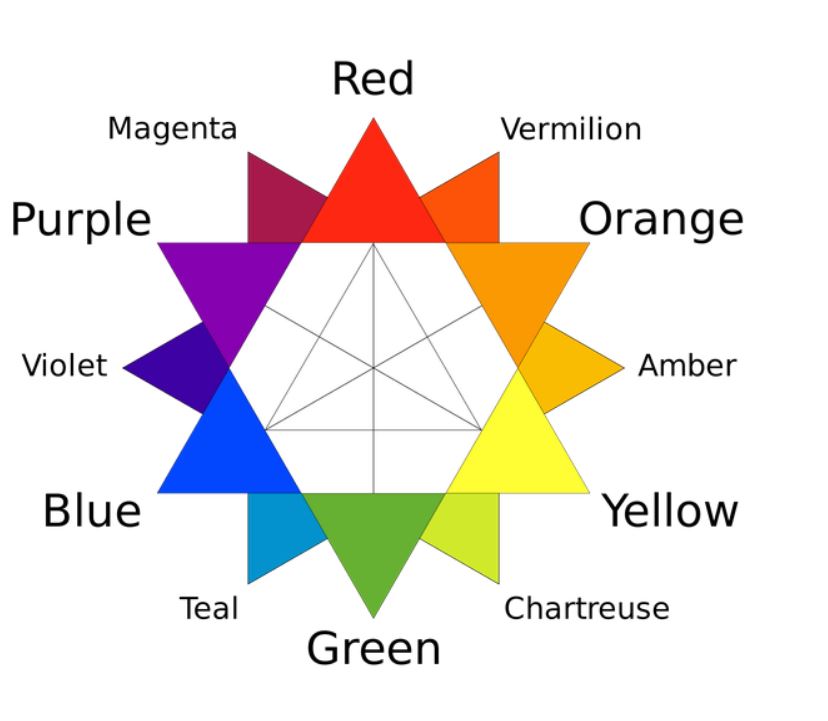
    I love color, and I am also fascinated by shapes. In my next life I might like to study sacred geometry. This image came up when I searched “What color does blue and red make?”
    My question about what color you get by mixing red and blue resulted from a recent post-puzzling conversation with two dear friends.

    Here is the photo of Linda and me with our completed puzzle, snapped by our hostess:
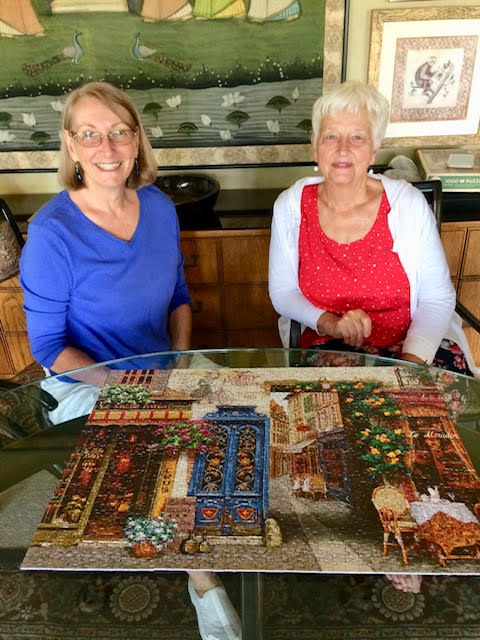
    Linda found it incomprehensible that neither Kathy nor I know which US party is represented by red, and which US party is blue!

    Our conversation had begun with questions about what I had learned at the recent Dharma Path Intensive. An inner journey is not easy to explain. When the word ‘politics’ came up, I said I could recall having heard Abraham Hicks say, “Politics is just outside of the vortex.”

    The next question was, “What is the vortex?”

    I was now trying to speak Buddhism, Abraham Hicks, and DebraESE. For this blog post, I will add some WilberESE to the mix!

    Maybe the questions about mixing the colors of red and blue might make things a bit more clear. The answer seems to depend if you are referring to pigment or light. Commonly people think about pigment. Mixing blue and red pigment, would result in purple or violet.

    However, if you are referring to light, which is additive color, mixing red and blue light produces magenta. Yikes….

    I found this reference to magenta online. It comes from Integral Theory (levels of consciousness) by Ken Wilber: Magenta Altitude tends to be the home of egocentric drives, a magical worldview, and impulsiveness. It is expressed through magic/animism, kin-spirits, and such. Young children primarily operate with a magenta worldview. Magenta in any line of development is fundamental, or ‘square one’ for any and all new tasks. Magenta emotions and cognition can be seen driving cultural phenomena.

    I am working with a few others to develop a blog called Words of Light, where the teachings of Aaron (as channeled by Barbara Brodsky) will be made available. This is a snip from one blog entry:

    The whole Earth is in process of growing through from the lowest level of consciousness, which has a very heavy vibrational frequency, to a higher and higher and higher consciousness. Just as you cannot rush the 2-year-old into the next level of consciousness, but must allow gradual transition, you cannot rush the Earth and the sentient life upon the Earth.

    But, just as your willingness to explain to the 2-year-old even though he doesn’t yet understand—to hold the door open to the next level of consciousness—is vital to his shifting into that higher level of consciousness, so your willingness to hold the door open is essential to the shift in consciousness in the Earth….

    We were all two. We were all teens.

    Also in that post, Aaron makes it clear that the levels of consciousness are not like floors in a building. They are more like intersecting planes. When lower levels of consciousness arise in us (Aaron says this happens in all of us), by being able now to see it for what it is, you do not get caught up in those early beliefs.

    Think of an election, not as two forces in opposition to each other, but really the higher consciousness inviting the lower consciousness.

    Higher consciousness is making the clear statement, “You cannot stay hidden there in such early childhood consciousness. You must move out.”

    Now this has my mind going to Wilber’s Turquoise Attitude…. Turquoise is a mature integral view, one that sees not only healthy hierarchy but also the various quadrants of human knowledge, expression, and inquiry (at the minimum: I, we, and it). Turquoise is the first to begin to integrate Spirit as a living force in the world (manifested through any or all of the 3 Faces of God: “I”—e.g. the “No self” or “witness” of Buddhism; “we/thou”—e.g. the “great other” of Christianity, Judaism, Hinduism, Islam, etc.; or “it”—e.g. the “Web of Life” as seen in Taoism, Pantheism, etc.).

    Perhaps I should do a search asking what two colors make turquoise….
  • Ambiguous Loss

    Last week was a week with loss. Good Friday, the husband of a client/friend/colleague passed. Holy Saturday, the father of a business acquaintance passed. Easter Sunday, a loyal member of Saint Joseph Buddhist Sangha passed. A Buddhist teacher invited me to use the 49 day ceremony.

    49 Day Ceremony

    When someone passes away, in addition to a funeral service that usually occurs three or seven days after the death, we have a ceremony on the 49th day. Traditionally, the period of 49 days after someone dies is seen as a time for that person to check their consciousness and digest their karma. According to Buddhist teaching the bodhisattva Ji Jang Bosal helps the deceased during these 49 days to perceive their karma so when they return they are reborn to help this world, rather than continue in the cycle of birth and death. Buddhism teaches that there is a life in this body, then a time of investigation or consideration, and then a new life …

    Loss is such a raw part of human life.

    Listening to a TED talk by Nora McInerny, I was moved to laughter and to tears. McInerny is the author of The Hot Young Widows Club: Lessons on Survival from the Front Lines of Grief.

    McInerny said something members of our Grief Journey Group have said to one another over and over for over twenty years: We don’t move on from grief, we move forward with it.

    The next day, opening the May 2019 Guideposts, I see, ‘A Different Kind of Grief’ by B’ette Schalk. Schalk felt she lost her husband to anxiety and depression, writing, “Gone was the vibrant man I’d fallen in love with 24 years earlier, the man who liked going to parties and playing cards.” The article closes with a single page with 5 headings of great wisdom for caregivers: How to Cope With Ambiguous Loss.

      How to Cope With Ambiguous Loss

      Put a name to it.
      Use “both…and” thinking.
      Accept that good enough is enough.
      Manage your mixed emotions.
      Imagine new hopes and dreams.

    Ambiguous loss is what my friend is living as her husband is in a facility for those with Alzheimer’s disease.

    Ambiguous loss is felt by students afraid to be at school for fear of a mass shooting.

    Ambiguous loss is felt in the aging and staging of life.

    On the light side of 40, she recently shared with me she had read on a website about cancer that having cancer was like living with a loaded gun pointed at your head. You did not know when it would go off, but you knew it would.

    Ah, ambiguous loss….

    Whether it is our youth, our goals, our jobs, our homes, our health, our strength, our courage, or our loved ones, or our memories, we all navigate the waters of ambigious loss.

    The best way I can think to close this post is with this Deep Spring Center Thought for Today:

    “Your loved one is not dead, only he has left his human form. He is now expressing himself through you, through your growing open heart that can allow itself the experience of grief and allow that grief to become a catalyst for compassion. He is expressing himself through you in all the ways he spoke to you in your life, the joys and the sorrows. He is expressing himself through every human that he touched in this lifetime. And he is in the soil and the stars and the rain and the sun. You cannot lose him.” ~ Aaron

    Whatever has the nature to arise has the nature to cease and is not me nor mine.

  • Carpe Diem!

    Gather ye rosebuds while ye may,
    Old Time is still a-flying;
    And this same flower that smiles today
    Tomorrow will be dying.
    The glorious lamp of heaven, the sun,
    The higher he’s a-getting,
    The sooner will his race be run,
    And nearer he’s to setting.
    ~ Robert Herrick

    My fingers have been missing in action from the keyboard as I have enjoyed spending time with a precious friend. We played dominoes, went sightseeing, dined with decadence, and shared about dealing with pain.

    Today I am catching up.

    This is the beginning of the February 6, 2019 daily thought of David J. Bloyd:

    “Memories— the one thing that can never be taken away from us. Make lots of them! “

    —Catherine Pulsifer, Canadian author; age not provided

    wiseoldsayings.com (website)

    ~~~~~~~~~~~~~~~~~~~~~~~~~~~~~~~~~~~~~~~~~~~~~~~~~~~~~~~~~~~~~~~~~~~~~~~
    But be careful…very careful…because it’s just as easy to form a bad memory as it is a good one. I recall a story I read many years ago. A family was on a trip in their car, carefully planned regarding timing and distances, and on-target to fulfill those plans. Their little boy was in the back in his car seat playing with his favorite stuffed toy. His window was open to give him fresh air. Suddenly he cried out that his toy was gone. The father asked where it went. “Out the window”, the boy replied. Now the father had three choices: Chew the little boy out and keep driving; just keep driving and let the little boy suffer the loss; stop, turn around, and go back to look for the toy. He chose the last option.

    Later, when with friends, the wife told the story. One of the friends asked the man “Why? Why did you ruin your schedule over an inexpensive teddy bear?”

    The father smiled and said “Because the toy was his favorite.”

    Now why is that important?

    Because whatever choice he took, it would have created a memory for the little boy—either a sad one or a marvelous one. We have future memories in our control. Whatever we do today we’ll re-live tomorrow.

    Reliving pleasant things is very pleasant. I have been doing some of that around my last week. Reliving unpleasant things can be even more unpleasant than the experience itself.

    My friend, Sheilana Massey, wrote Peace Has No Space for Memories. The book encourages us to live in the moment of right now, without dragging in the past or living in the future. She says we can live with Love for what is, not for what was or what will be. From this space our planet will move into Peace, Love and Joy for all Creation.

    The Buddha taught that we cannot prevent pain, but we do not have to suffer. “In life, we cannot always control the first arrow. However, the second arrow is our reaction to the first. And with this second arrow comes the possibility of choice.” (A search for ‘the second arrow’ will yield lots of pages, or check out How the Buddhist metaphor of ‘the second arrow’ can help you to be nicer to yourself.)

    This is often summarized as, “Pain is inevitable, but suffering is optional.”

    My friend is enduring a lot of pain.

    Amidst the pain, however, she is ecstatic about her new life with her new husband. She eats with enthusiasm. She loves music. She laughs a lot.

    Whatever we do today we’ll re-live tomorrow.

    Gather ye rosebuds while ye may… Cease the day!

  • Cultural Peace

    Time is at once a limited commodity and an illusion. We an spend time, waste time, deny time, and transcend time.

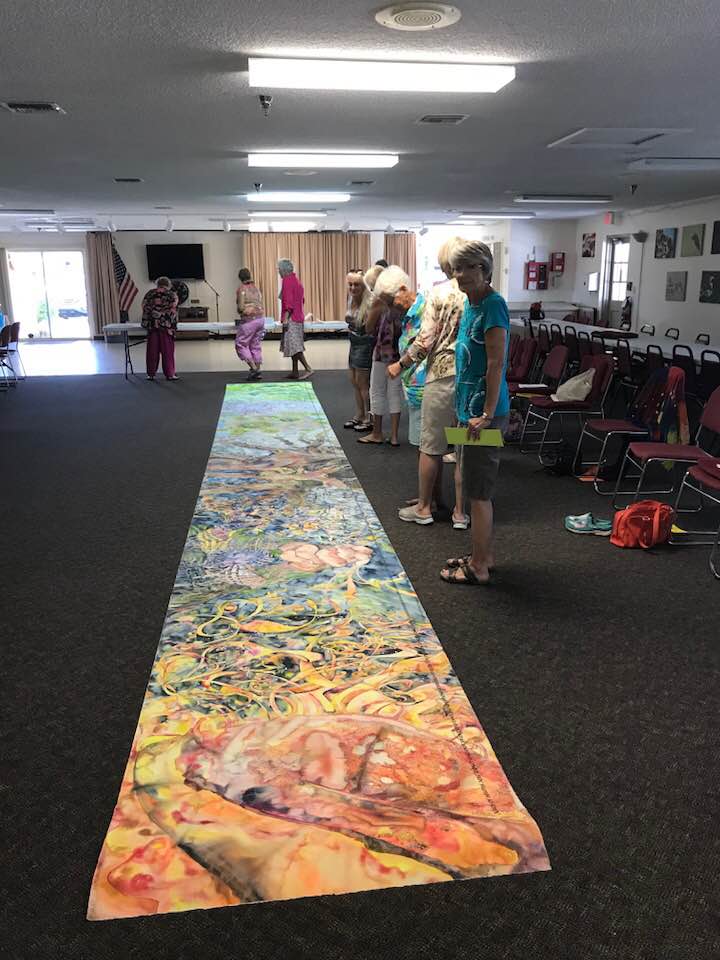
    At a workshop with Zan Henigan Lombardo, the focus was on how she let chaos in her life create something beautiful. Her work of art is an impressive 30-foot watercolor painting with an equally impressive 30-foot poem along the bottom, created by an even more impressive artist/poet/teacher over many years.

    As is the case in most group settings right now, the most recent school shooting came up. People from all walks of life are asking why, and some are asking what can be done. This morning I read again Glen Snyder’s article (Lion’s Roar is from the Buddhist perspective) which invites some possible answers to the question how. The article is titled Why We Go for the Gun. Greg Snyder is a Zen Buddhist priest and President of Brooklyn Zen Center. You may want to take time to read his article for yourself. Here is a brief excerpt:

    This is not to say we should not work for legislative change, organize to reduce homicides and suicides in our communities, stand up to systemic violence and law enforcement abuses, critically engage our own consumption of violence as entertainment, and actively address our nation’s child-soldier problem (that is, gangs). But these efforts alone will not change the soil in which this violence grows. We must illuminate this culture of domination, grieve our shared karma, and introduce the sacredness of spirit and all life back into our nation.

    Glen’s article touched a sensitive spot for me. As my husband is in the living room watching TV in the evenings, I am often in the other room working on a jigsaw puzzle. Hearing the soundtrack only of what he is watching, the movies he watches all sound the same. I hear two hours of gun shots, guttural grunting and desperate breathing, along with the repetitive use of the four-letter-nasty. I told him I don’t think they even make individual sound tracks….

    Reading Glen’s article, the thing that was most salient for me is how what I think, say, and do contributes to our collective experience. This morning I appreciated today’s thought from the Brahma Kumaris:

    The ability to enjoy one’s own company is one of the greatest gifts life has to offer. Learning to turn my thoughts away from all my responsibilities at the day’s end and take my mind into a state of peace and benevolence enables me to carry greater and greater loads without feeling the burden. When my inner landscape is full of beautiful thoughts, everything I do is a pleasure. Gently, I calm down chaotic situations and offer solace to troubled minds.

    Perhaps enjoying one’s own company and cultivating the sweet sound of silence is the how of inner and cultural peace….

  • Tip of a Wish

    The idea of a perfect parent, perfect partner, or perfect day makes some people nervous. They think of all the ways things don’t measure up. A headache, a heartache, or an unfulfilled longing seems to stand in the way of perfection.

    Imagine for a moment an eternity without sunshine, or rain for that matter. Perfection is organic, not static. This moment is perfect.

    Listening to a talk about what karma is and isn’t has me thinking about all of this. Karma is not punishment; it is cause and effect. Whatever we are experiencing at any given moment had its roots in the “past” and it is planting the “future.” This moment is perfect.

    Robina Courtin, quoting a Buddhist teacher says it this way, “Everything exists on the tip of a wish.”

    To fit with Valentine’s Day, I wrote a wellness tip about hugs:

    Hug for Health!
    by Debra Basham

    Debra’s Wellness Tips

    Well, it seems that love and companionship is good for your health. People in love and those with good relationships have lower blood pressure, less depression, and report feeling better over all.

    We like to hold hands, get hugs, and make whoopie. In most cases, love and wellness go hand-in-hand.

    This week, snuggle up. And it is not just people we love to touch. Petting our pets has health benefits, too.

    A dear friend commented, “I am single and have no pets. Does that mean I am destined for depression?” I wrote back telling her to take an I NEED A HUG sign to a busy place and give a blessing (what is called drishti in Hindi) to everyone who stops. I reminded her of Amma, the hugging saint.

    The wind is blowing today. I have an opinion it might be a more perfect day if it weren’t quite so windy.

    My abdomen is not quite as flat as I might think perfect.

    What I do with these thoughts, feelings, and beliefs really does make a difference now and long into the future.

    Rollo May said it this way, “If you do not express your own ideas, if you do not listen to your own being, you will have betrayed yourself.”

    What is on the tip of your wish today?

    I wish you a perfect day!