Tag: alcoholism

  • Howard and Karen

    My stomach’s rumbling reminded me it was almost dinner when I noticed a woman moving swiftly from door-to-door across the street from our home here in Glenaire. It caught my attention firstly because neither of the two houses are currently occupied. Directly across, friends are navigating health challenges that have prevented them thus far returning from their snow-bird location. And a new-build adjacent is yet to be purchased.

    I could see a vehicle parked in front of our house and a man came onto our porch but then quickly dashed away. Opening the door, I saw a handbill had been taped onto the glass. “There is no solicitation in the park,” I called out to him.

    “It is not a solicitation, it is a courtesy,” he called back.

    There was the logo of a roofing company, announcing they would be putting on a roof two doors down, apologizing for noise, saying it would be done in one day. The phone number of the company was at the bottom. “It looks a lot like solicitation to me,” I said while I went down the steps to return the paper. He muttered something about it looking however, and saying I could refuse the courtesy if I wanted to as he started walking quickly in the opposite direction.

    It was not a pleasant interaction so I decided to grab my phone and get the license plate. The woman had crossed the street by this time and she started hustling back my way calling loudly, “Karen!” I asked if she had gotten permission from the management, and when she called me Karen again, I asked why she kept calling me something other than my name. “Look it up, Karen!” she yelled, adding, “Don’t bother calling the manager, I am going there myself.”

    An internet search informed me “Karen” is a pejorative slang term used to describe a person—typically a middle-aged white woman—perceived as entitled, demanding, and overly indignant. The term is used to call out behavior that abuses privilege, such as demanding to “speak to the manager,” making racist or discriminatory remarks, or harassing others in public.

    Hmmm…. her behavior was certainly not very professional! I did call the park manager, and she had gotten to the office before my call. I clarified that her notifying the office of their “courtesy” only took place after my exchange with them. I asked him if he would have given them permission had they stopped before. He said he would have told them there was no solicitation allowed but he would notify the neighbors himself.

    I was shocked how dis-regulated my central nervous system was by the exchange. But the painful and the pleasant can be a dance duo.

    This morning, sharing text with my niece about the anniversary of my father’s (her grandfather’s) passing on May 7, 1992, we spoke our gratitude of his having found sobriety before my sisters and I had children. The grandchildren were spared. She wrote, “Mom and I both benefited from Neil T. Anderson’s work. One of the ways he summarized the Biblical principle of forgiveness/unforgiveness is how when we forgive, it lets that person off our hook (no more control or connection) but it doesn’t let them off the Lord’s hook (whatever unrepentant sin they have in their lives, they will be accountable for).” This shows up clearly in the teachings about karma. My dad’s active alcoholism was very unpleasant. His decades of sobriety before his death was very pleasant.

    A few days ago welcome warm air waffled into the house through the open windows as flies were also getting in. The pleasant and the unpleasant dance as a duo. After catching and releasing 4 flies (also seeing John kill one with the flyswatter) I looked up the spiritual meaning and read:

    The spiritual meaning of a fly combines contrasting themes of relentless persistence and survival with messages of decay, negativity, and spiritual impurity. It symbolizes the need to adapt, overcome obstacles, and examine one’s life for negativity.

    As my eyes and heart took the unpleasant and the pleasant in, what was revealed was grace and forgiveness. I recalled a time in my life when financial fears and genuine desire to help hurting people resulted in my seeing clients by circumventing the health insurance system. My actions, like this roofing company’s, were in a while-not-quite-illegal-definitely-not-fully-ethical manner.

    That neighbor’s new roof went on yesterday. How am I like this too? Awareness with non-judgment is healing….
  • Overcoming Addiction

    Start by doing what is necessary,
    then do what is possible,
    and suddenly, you are doing
    the impossible.
    ~Francis of Assisi

    “Addiction, it has been said, starts in pain and ends in pain.” This is the opening line in the Editor’s Note in the January, 2018, edition of GUIDEPOSTS. The title is ‘Overcoming Addiction.” The entire edition is dedicated to the hope of recovery that calls to every addict and the people who love them.

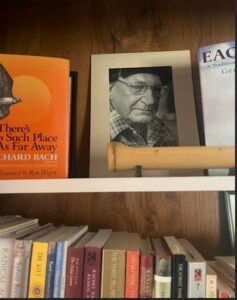
    I am no stranger to addiction. My dad was an active alcoholic throughout my childhood. I am so grateful for his sobriety that came after my marriage and remained for the rest of his life. Grateful my daughter and grandchildren knew him in his sobriety.

    Last evening we were with some friends. This past week has been about her facing her son’s alcoholism. Several times during the evening I would be aware of the smell of alcohol. No one else could smell it, but it was obvious to me. Eventually I said, “It must be my dad.”

    Richard Rohr, an American Franciscan Friar ordained to the priesthood in the Roman Catholic Church, published a podcast titled “Contemplation and Action on the Road of Recovery.” Rohr’s message begins with the radical truth that we are all addicted. He says the universal addiction we share is our addiction to our way of thinking. He says, “Literal-ism is the lowest level of meaning, the least level of meaning. Literal-ism gets you nowhere.”

    Whether taking something personally, literally, or insisting our way is the “right” way, addiction to our way of thinking is one of the most important things we can choose to give up. What would that be like? Recovery.

    Recovery is simply this: union with reality.

    Overcoming addictions is simply this: union with reality.

    Addiction is anything we know is not good for us but we do it anyway. So how do we change this?

    Here is a poem I wrote on September 25, 2017.  It is titled ‘Addiction’s Daughter.’

    His blood shot eyes told the story

    Her words a sloppy slur

    The arguments, lies, disappointed children staring

    wistfully out into space


    Alcohol’s real name is Satan

    Fermented devil Scotch

    And pray tell how one can in his right mind call it smooth

    a true velvety swindler


    Our broken dreams lie there shattered

    Memories all scattered

    Perfection in work and play disguising inward scars

    all weeping done in silence

     
    All weeping is done in silence in addiction. It is important we speak honestly. It is important we choose wholesome actions that invite recovery. It is important our awakened heart is capable of being present for our own suffering and the suffering of others.

    I have found the practice of Tonglen helps to awaken the heart.

    A Variation on Tonglen (receiving/giving) Meditation

    (Instructions in parentheses are a variation for Christians.)

    1. Sitting erect, note the breath moving in and out. Feel yourself in a circle of light (of God’s or Jesus’ presence, His Heart to your heart).
    2. Breath in, feeling that Light and infinite love move into you.
    3. Breath out. Let it fill your heart.
    4. Breath in, note the immense suffering of the world, then direct focus to one place/person.
    5. Breath out, sending that Love with the exhaled breath, to this suffering being. Here we are allowing ourselves to give freely, not to hold that Light which is so precious for ourselves but offering it freely in service to others.
    6. Inhale. See the suffering as a black, thick, tarry mass. Allow yourself to draw it into your heart. Note any resistance, any fear of allowing in that suffering, any desire to stay separate; soften around it. This is not a matter of forcing oneself, but gently opening one’s heart to fear, to the fear that creates illusion of our separation from the suffering of the world. We MUST do it gently. If there is resistance, allow in as much as you can. No ‘shoulds,’ no judgment, just the heart that gently opens when its fear is met with mercy.
    7. Exhale, allowing yourself to feel the heaviness of the suffering.
    8. Inhale, (remembering God); we as human need not hold the suffering and bear it ourselves.
    9. Exhale, release it out to whatever accepts it (to God or to Jesus).

    Lokah Samastah Sukhino Bhavantu is a Sanskrit mantra which means:

    “May all beings everywhere be happy and free, and may the thoughts, words, and actions of my own life contribute in some way to that happiness and to that freedom for all.”

    By chanting this mantra, we move from our personal self and radiate a prayer of love for the world around us. It takes us from the egoic, little self, and its limited world view, and radiates from us global wellbeing. It is a reminder we are a part of the universe and can positively impact all of creation.

    May all beings everywhere overcome addictions….